
You stare at two spreadsheets—one shows branded vape margins, the other shows private label margins. The private label number looks bigger. You pick it. Then your cash sits frozen for months while branded stock sellers lap you three times.
Branded stock often beats private label for wholesale growth because it unlocks faster cash turnover, smaller order sizes, and immediate delivery. Your money can work three to four times while a private label order is still somewhere between production and customs.[^1]
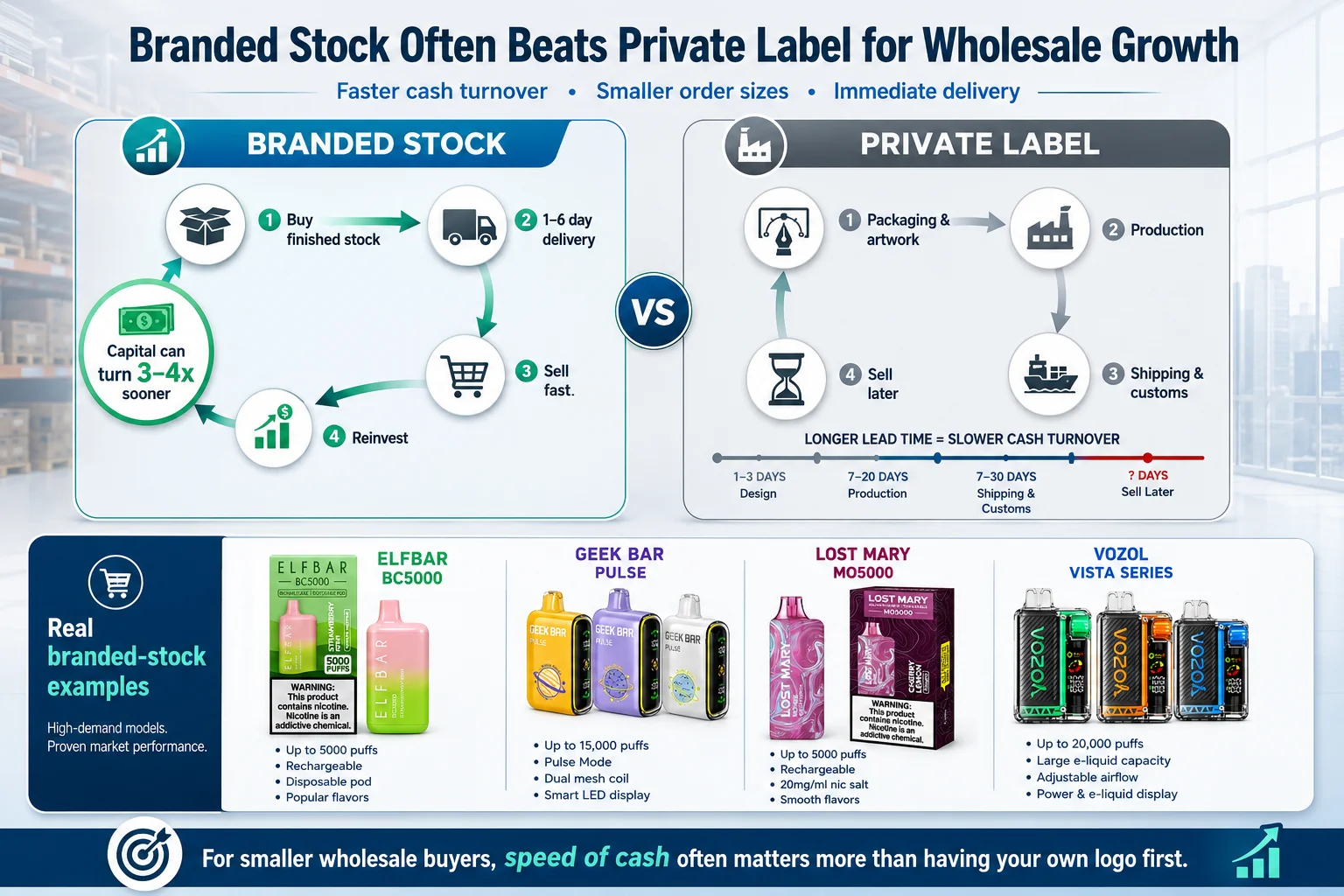
Most wholesalers get this wrong. I have seen it too many times in my 14 years of vape supply. The conversation starts the same way: "King, I want my own brand so I can make more money." And I always ask one question—how fast can you sell what you already have? That question usually stops them. Let me walk you through the real math, the hidden costs, and why branded stock is often the smarter engine for growth.
What Does Branded Stock Mean in the Vape Wholesale Business?
You think selling other people's brands means you are just a middleman. I thought that too once. But middlemen who move fast build empires.
Branded stock means buying finished vape products that already carry a manufacturer's brand name and packaging. You resell them to retailers without changing anything. The brand recognition already exists, so you skip the slow work of building demand from zero.
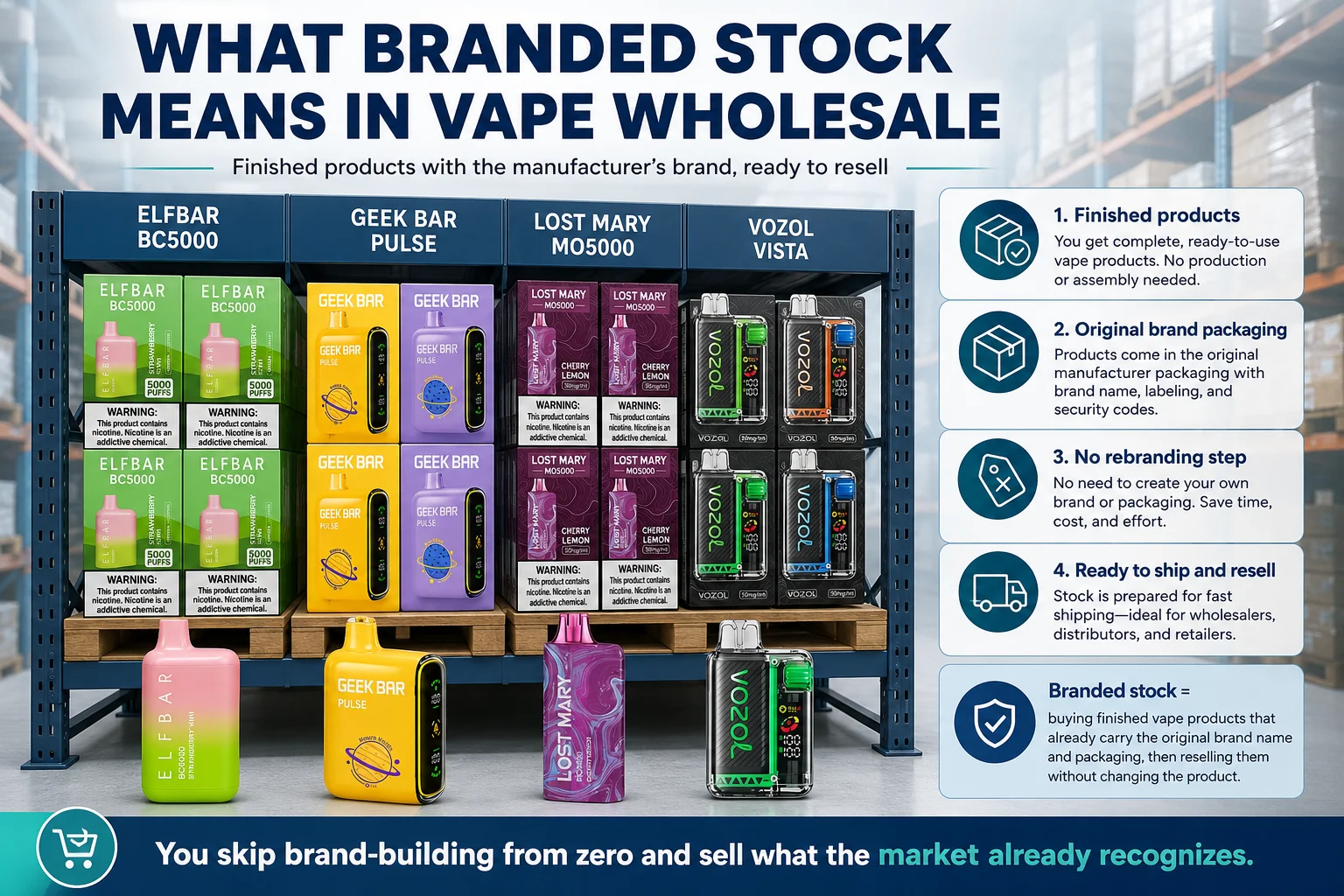
Many wholesalers confuse branded stock with white-label or generic products. Branded stock usually comes from known names like Elf Bar, Lost Mary, or other popular lines. The consumer already recognizes the package. When you walk into a vape shop, the shop owner knows what it is. That recognition cuts your selling time dramatically.[^2] I remember a client in Spain, Mr. Zhang, who started selling branded disposables. He did not need to explain the product to his shop customers. They just saw the familiar box and ordered. His first pallet sold out in two weeks. With a private label, he would have spent weeks just convincing retailers to try an unknown name. Branded stock does the marketing work before you even touch the product. For a wholesaler who wants fast turnover, that head start is everything.
Branded Stock vs Private Label Vape: What Is the Real Difference?
You assume private label just means putting your logo on the same vape. That assumption will cost you months of tied-up capital.
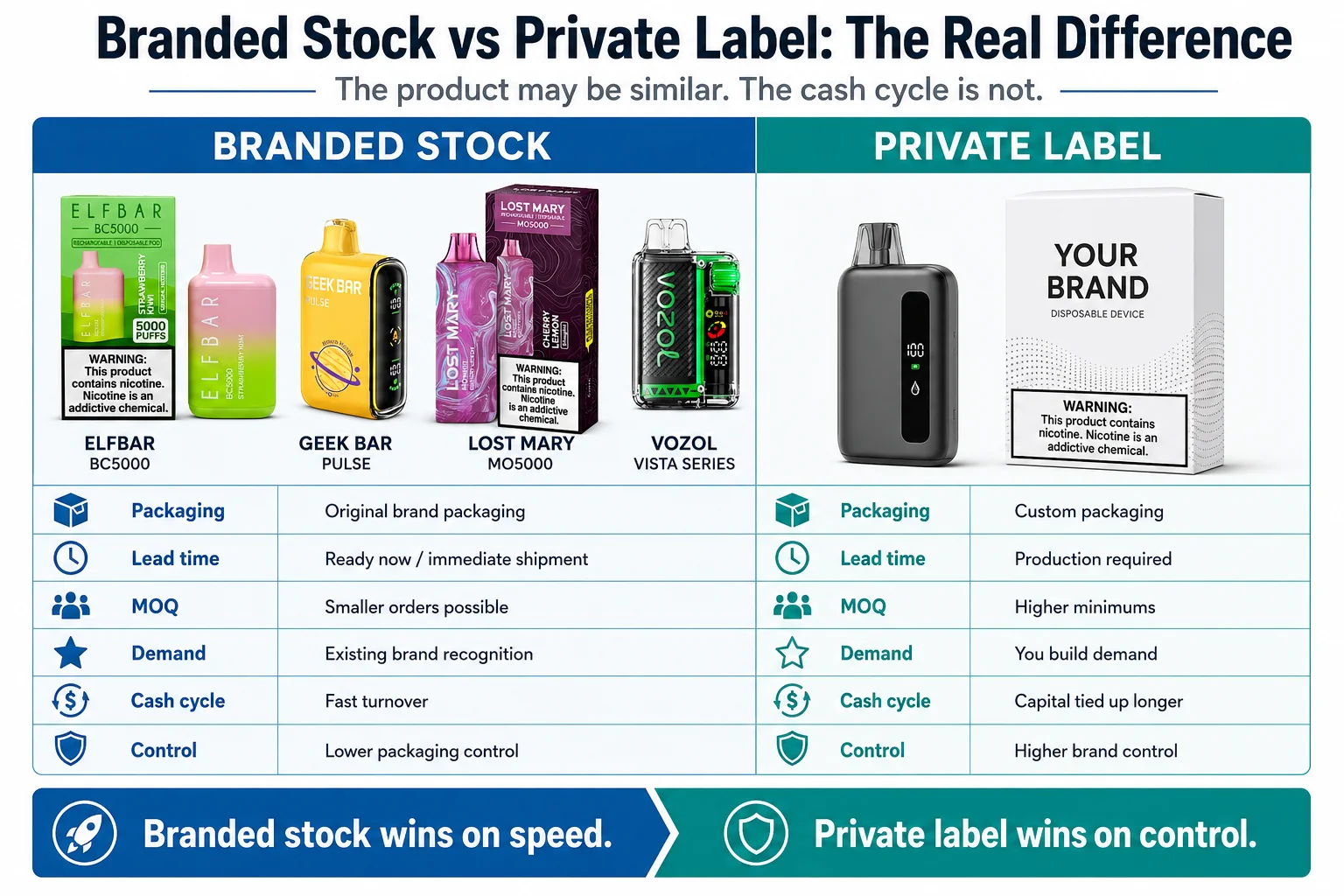
Branded stock is ready to ship immediately with existing brand packaging. Private label means you order production, choose packaging, and wait for manufacturing. The product itself may be similar, but the time, risk, and cash cycle are completely different.[^3]
The Real Cost Difference Beyond Unit Price
I keep a simple table in my head when I talk to clients. Here is what I tell them:
| Factor | Branded Stock (from our EU warehouse) | Private Label / OEM (from China) |
|---|---|---|
| Minimum order | 50 pieces per SKU | 2,000–5,000 pieces per SKU |
| Lead time to your door | 1–5 working days | 30–60 days (plus customs) |
| Cash cycle | Sell in 2 weeks, reorder 3–4 times per year | Wait 2 months, sell 2 months, recycle maybe twice a year |
| Brand recognition | Instant, consumer already knows it | Zero, you must build it |
| After-sales risk | We handle warranty, you get replacement | You negotiate with factory; often you eat the cost |
| Financial risk | Low, because capital is not locked long | High, one customs seizure can wipe out the whole shipment |
Private label looks cheaper per unit. But when your money is stuck for four months, you miss opportunities. I have seen a client who ordered a 3,000-piece private label shipment. The factory delayed two weeks, customs held it another three weeks. By the time goods arrived, the market trend had shifted. He had to discount heavily.[^4] Meanwhile, another client who bought branded stock from our Poland warehouse sold through three batches of the same product type in that same period. She made less per unit but more total cash because she recycled her capital faster. The math is simple but not obvious.
Why Branded Stock Can Be Faster for Smaller Wholesale Buyers
You think you do not have enough money to start a wholesale business. You are wrong. Branded stock lets you start with less and grow faster.
Smaller buyers can buy as few as 50 pieces of branded stock from a European warehouse and receive delivery in 1–5 days.[^5] They sell quickly, reinvest, and repeat. This cycle builds momentum without large upfront capital.
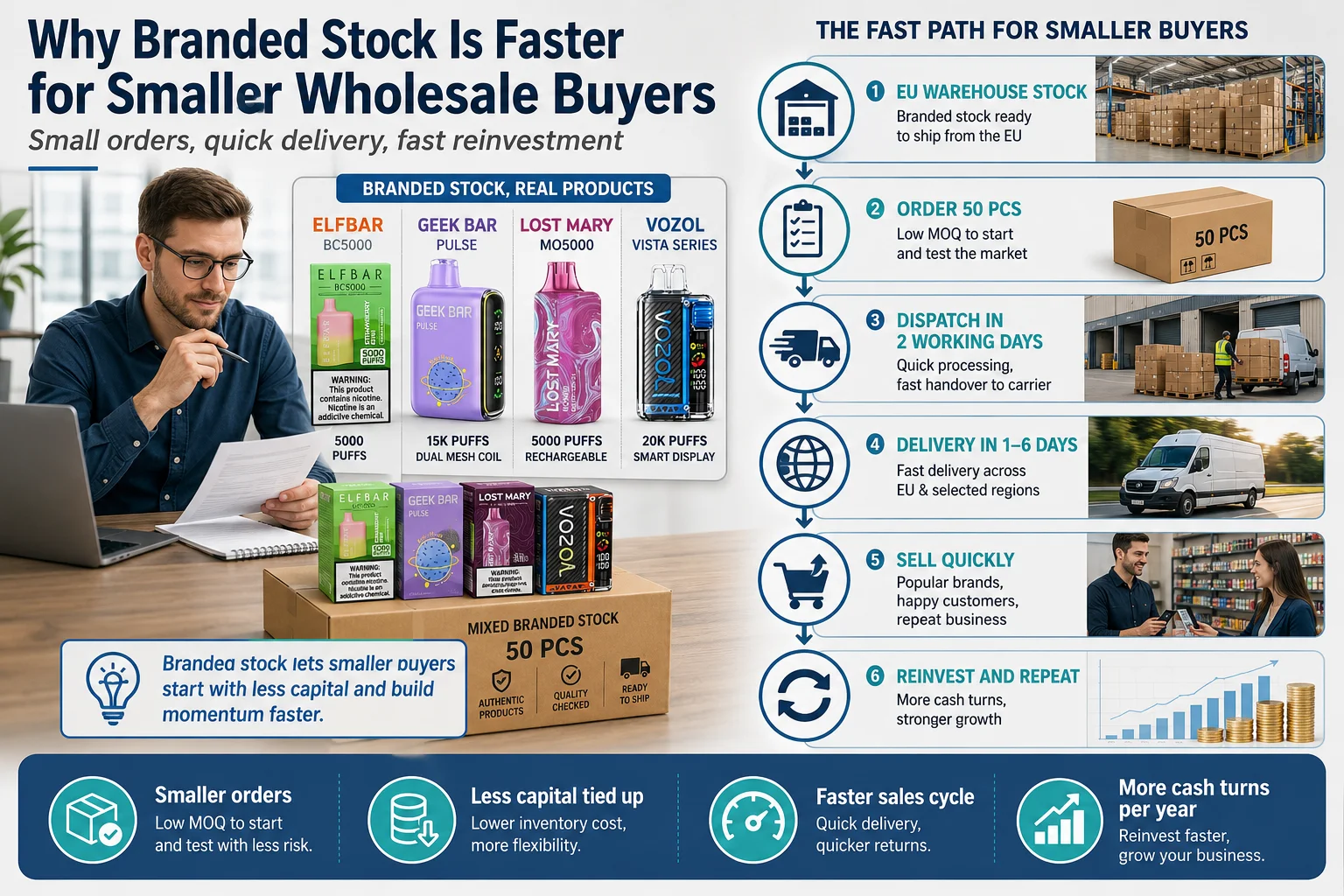
I worked with a client named Iyad Moreb in the US. He started with a few thousand dollars. He wanted to enter the disposable vape market but worried about ordering containers from China. I told him to use our branded stock first. He bought 50 pieces of five different brands. He walked into local vape shops and gas stations with samples. Orders came in. He reinvested the next day. Within three months, his purchasing power grew five times. He later started doing OEM with us, but only after he had a steady cash flow. The small-branded-stock model works like training wheels. You learn the market, you build customer relationships, and you never gamble more than you can afford to lose. When a shipment from China gets stuck, a small importer can go bankrupt.[^6] With branded stock from a local warehouse, you are never more than a few days away from restocking. Speed is your safety net.
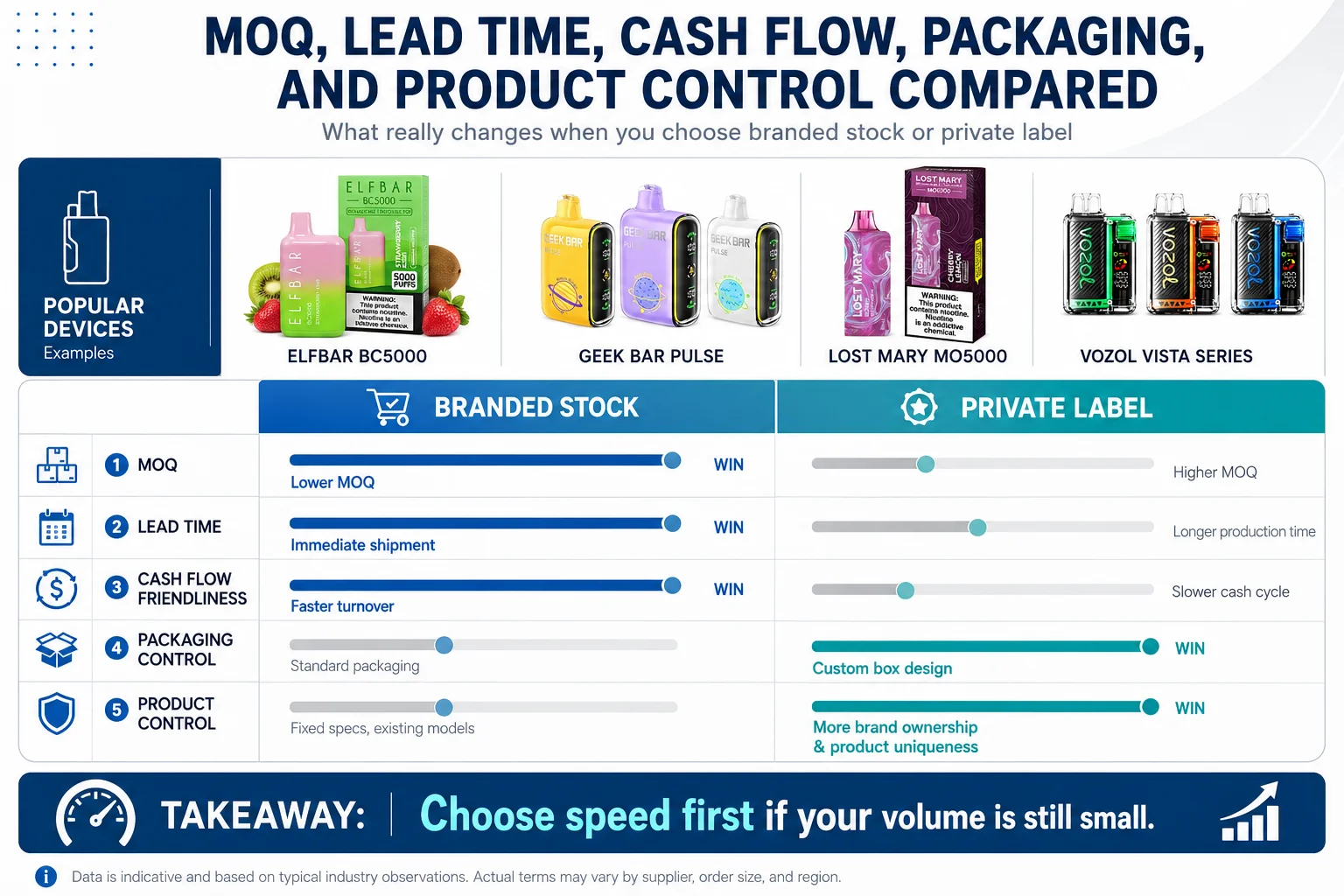
MOQ, Lead Time, Cash Flow, Packaging, and Product Control Compared
You measure products by the price tag. I measure them by how fast they turn into cash. That one change in thinking will shift your whole business.
Branded stock wins on MOQ, lead time, and cash flow friendliness. Private label wins on packaging control and product uniqueness.[^7] But those advantages only matter when your volume is already high enough to absorb the slow cash cycle.
A Simple Cash Velocity Calculation
Let me share a story with real numbers. A client asked me whether to put $10,000 into branded stock or private label. Branded: cost $5 per unit, sell at $8. Profit $3 per piece. Private label: cost $3 per unit, sell at $8. Profit $5 per piece. On paper, private label looks better. But here is the hidden part:
- Branded stock: $10,000 buys 2,000 units. Sell in 3 weeks. Restock. Sell again. In 4 months, she can turn the money 4 times. Total profit: 4 x $3 x 2,000 = $24,000.
- Private label: $10,000 buys 3,333 units (but MOQ is often higher, so maybe she needs to borrow more). Production takes 6 weeks, shipping 4 weeks, customs 2 weeks. Goods arrive in month 3. She sells in month 4 and 5. In 4 months, she might turn the money only once. Profit: 1 x $5 x 3,333 = $16,665.
The branded stock delivered $7,335 more profit in the same period. And that is without counting the risk of shipment delay or quality issues. Many clients forget to include time in their profit equation. I always ask: "How many times can you spin that $10,000 this year?" The answer usually tells them which path to choose.
When Should Buyers Choose OEM, ODM, Private Label, or Own Brand Vape?
You think moving to your own brand is the sign of success. It is. But only when you reach the right stage. Jump too early, and you break your legs.
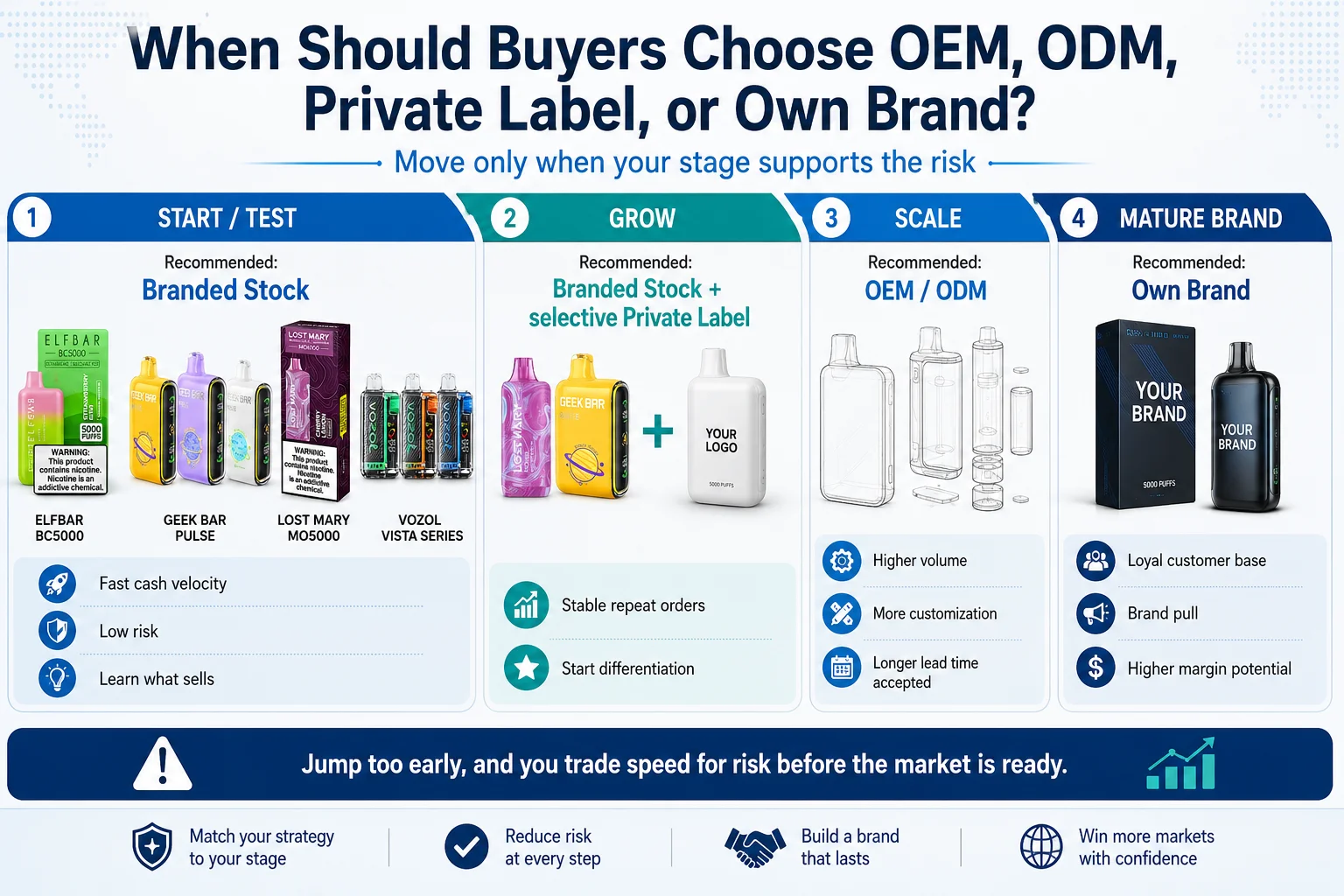
Choose branded stock when you are starting or growing and need cash velocity. Move to OEM/ODM when your monthly sales volume is stable and high enough to absorb the longer lead time and higher risk. Own brand comes after you have a loyal customer base.
The Three Growth Stages I See Every Day
I have watched hundreds of wholesalers grow. Most follow a clear path:
| Stage | Model | Why | Risk Level |
|---|---|---|---|
| Launch | Agency/branded stock | Test market, build cash, learn demand | Low |
| Growth | Branded stock + small OEM trials | Keep cash moving while testing unique products | Medium |
| Mature | Own brand / private label | Differentiate, lock in margins, control distribution | High (but manageable with experience) |
A client in Germany started with branded stock from our warehouse. After six months, he knew his best-selling flavors. He ordered a small OEM run of 500 pieces with his own logo on a proven design. He sold those alongside the branded stock. The branded stock paid the bills; the OEM experiment added extra profit. Now he is moving more volume into his own brand. He never had to take a big gamble. That is the smart way. I will never tell a client to skip branded stock. It is the foundation. Without it, you are building a house on sand.
Common Mistakes Buyers Make When Moving Too Early into Private Label
You have a logo, a dream, and a container order. Six months later, you are still paying for storage. That is the most common story I hear.
The Hidden Costs That Destroy the Math
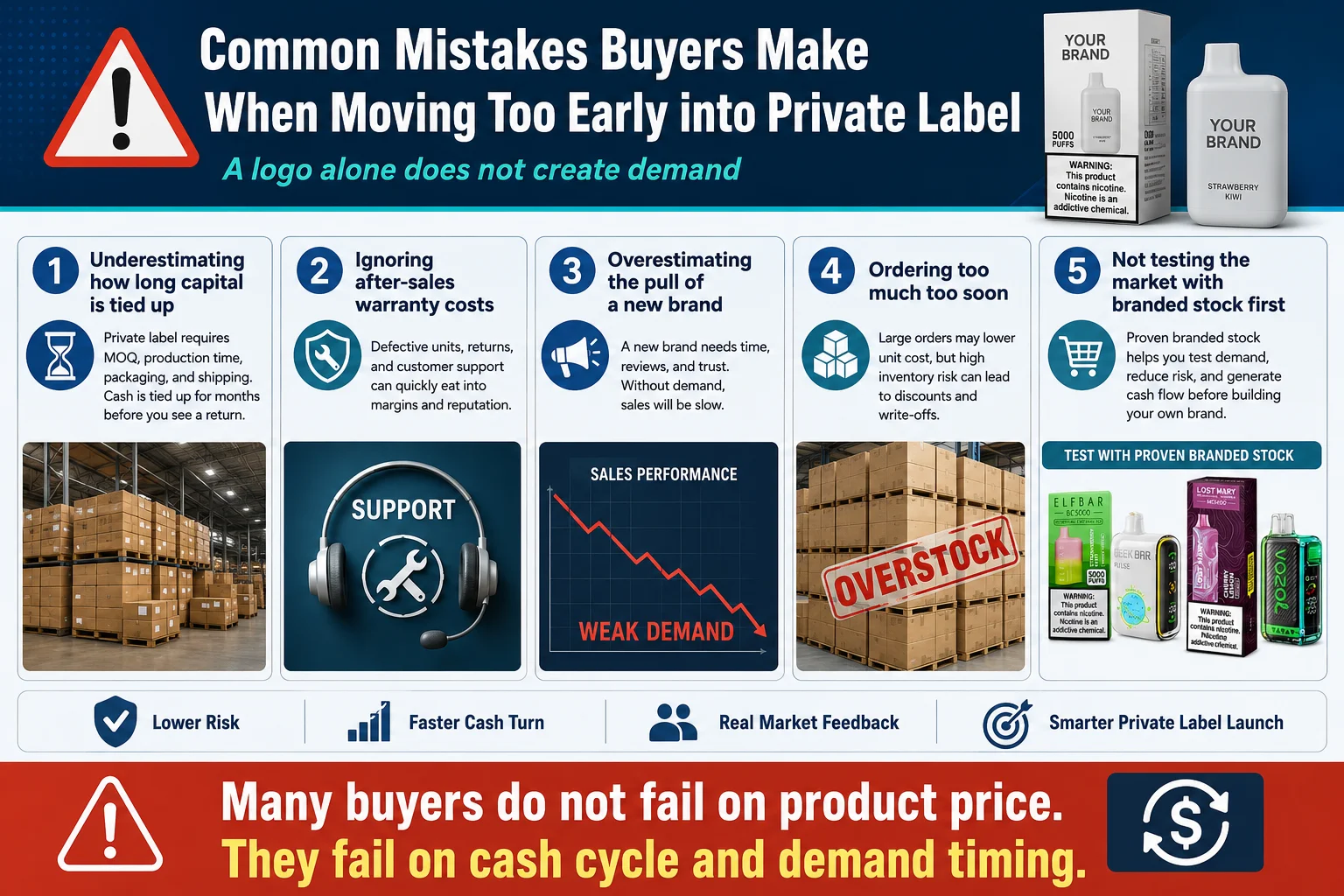
I once had a client who insisted on private label for his first order. He paid $15,000 for 3,000 custom devices. The factory had a two-week delay. Then the ship was delayed. Then customs inspected the container. The goods arrived four months later. Two of the flavors were not popular. He had to sell below cost. He blamed the market. But the real problem was that he could not react fast. If he had bought branded stock, he could have tested flavors in small batches and adjusted every few weeks. Instead, he was stuck.
Another hidden cost is after-sales. When you buy branded stock from a reliable agency, we handle defects. If a customer reports a dead battery, we replace it. With private label, you often have to negotiate with the factory yourself. If the factory is slow or uncooperative, you lose trust with your retailers. I have seen a wholesaler lose a big account because of a 5% defect rate that the factory refused to fix. Branded stock places that risk on us, not on you. For a small or medium wholesaler, that protection is worth more than the extra margin.
How Agency, Branded Wholesale, and Own-Brand Models Fit Different Growth Stages
You think all suppliers are the same. They are not. Some push you into OEM because they make more money. I push you into what makes you survive and grow.
The agency model (buying branded stock from a distributor like us) is for speed and low risk. Branded wholesale is for scaling. Own brand is for dominance. Your choice must match your current stage, not your future ambition.
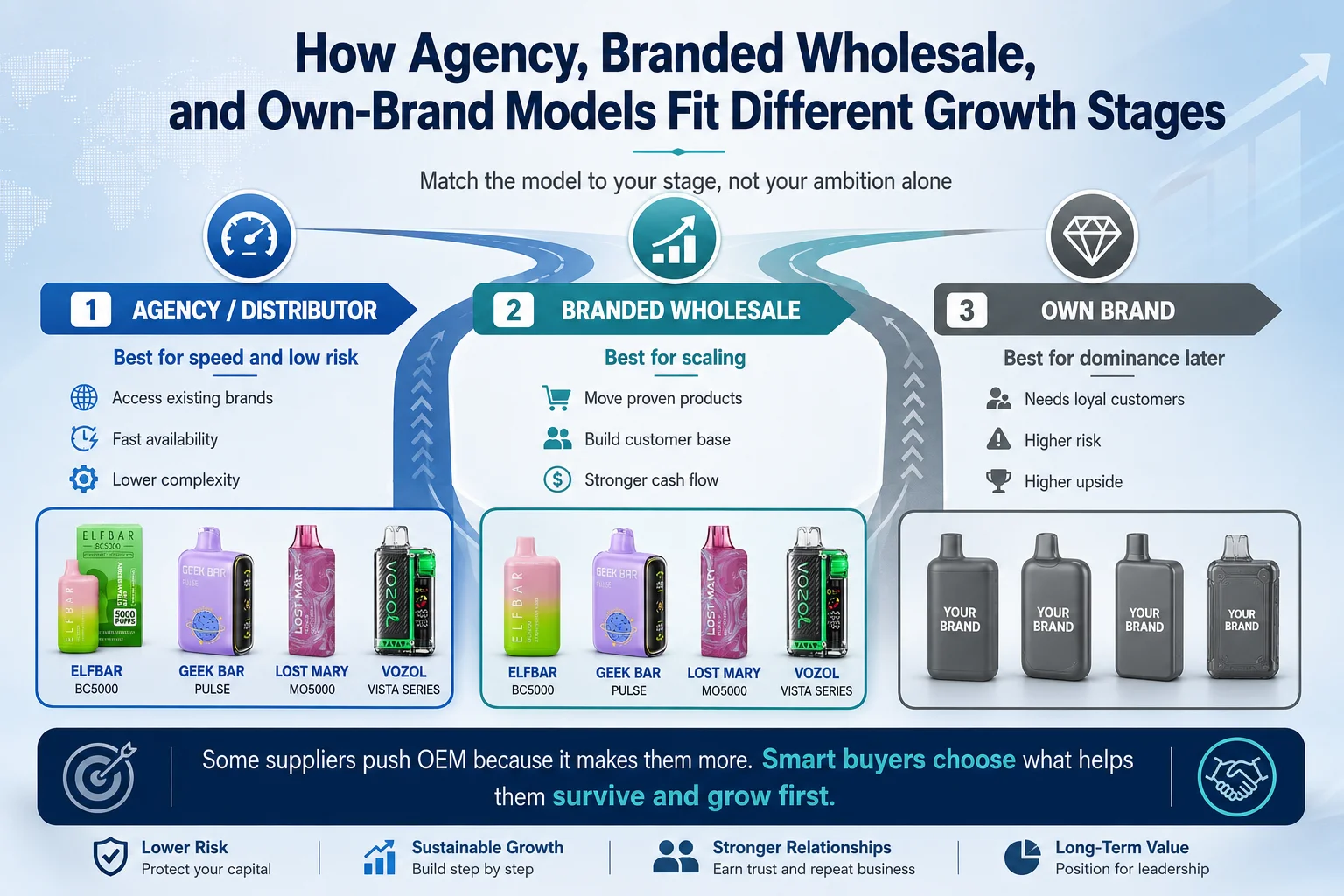
I have built my business around this transition. We are not just a factory. We hold branded stock in European warehouses so you can start small. We also have a 5,000-square-meter factory for OEM when you are ready. I tell every client: "Do not skip steps. Use our branded stock to build your cash engine. When the engine is loud enough, we will help you build your own brand." I have seen clients who tried to go straight to own brand. They often crawl back to branded stock to recover. The ones who follow the stages end up with a branded stock business that funds their own brand. That is the safest, fastest route I know.
How to Choose Practical OEM and Branded Vape Supply Options for Your Stage
You have a dozen options and no clear way to decide. I will simplify it. Look at your cash cycle, not your product catalog.
If your capital turns less than three times a year, stick to branded stock. If you have stable monthly orders above 5,000 pieces, test small OEM runs.[^9] The best strategy often mixes both: branded stock for speed, OEM for margin.
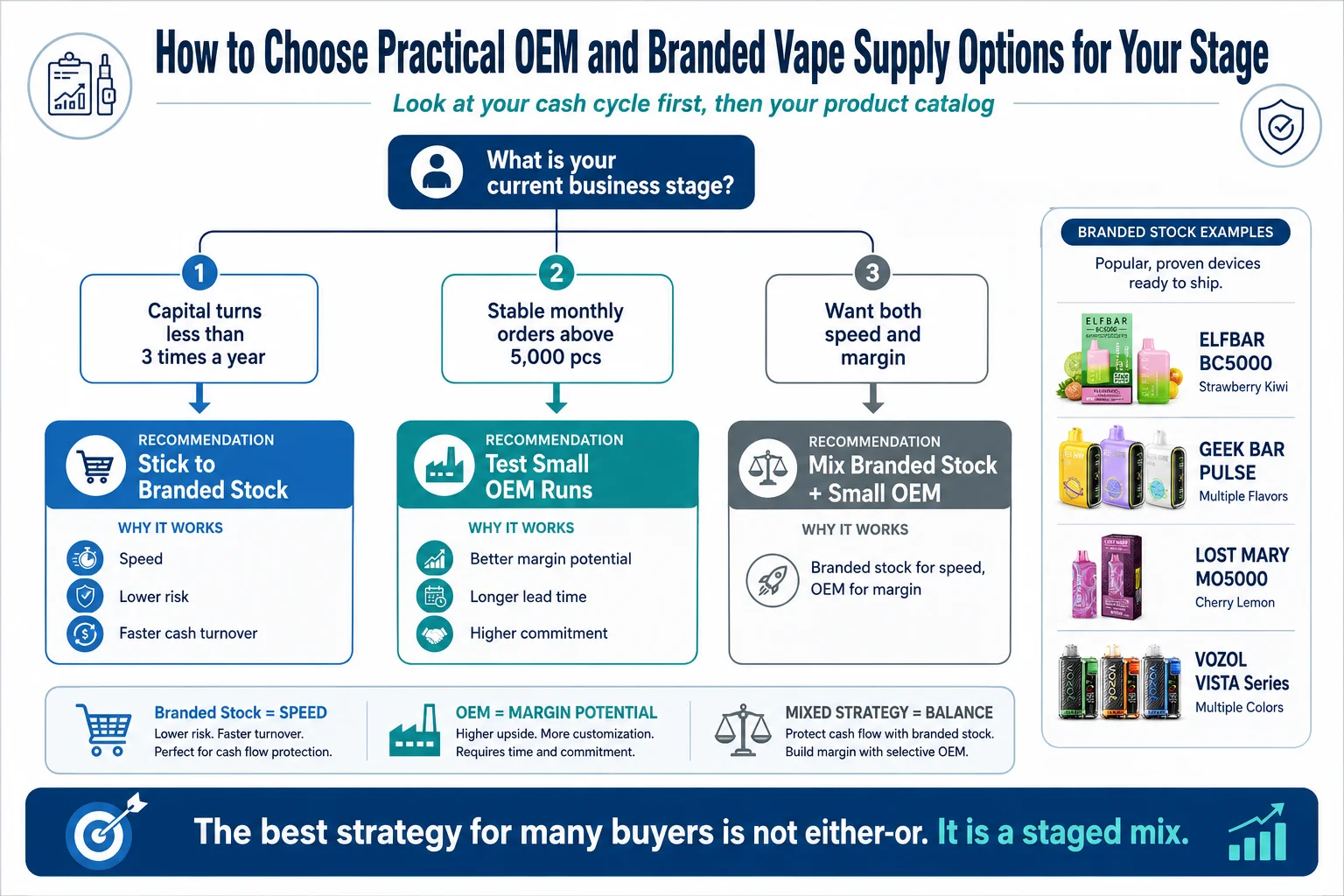
I have a client in Poland who orders 200 pieces of branded disposable vapes from our German warehouse every two weeks. At the same time, he places a 2,000-piece OEM order from our factory in China every three months. The branded stock gives him constant cash flow. The OEM order gives him a better margin on the products he knows will sell. He never risks his whole month on one shipment. That hybrid model is what I recommend to most growing wholesalers. You get the safety of branded stock and the extra profit of OEM, all without putting your business at risk. If you are not sure where to start, send me an email. I will look at your situation and tell you honestly which path fits. I have seen too many people lose money because they chose the wrong model for the wrong stage. I want to see you win.
Conclusion
Branded stock is not the cheap option—it is the fast option. It protects your cash, speeds up growth, and buys you time until you are ready for your own brand.
OEM and Private-Label Vape Sourcing
For buyers building their own brand, we provide OEM/ODM and private-label vape manufacturing with factory verification. Explore our manufacturing capabilities or request a quote.
Related reading: How MOQ Changes Between Branded Stock and Private Label Vape Projects
[^1]: "Inventory Turnover Benchmarks by Industry | Netstock", https://www.netstock.com/blog/benchmark-inventory-turnover-by-industry/. Faster inventory turnover is widely linked to higher return on capital in wholesale distribution, with academic models showing that reducing lead times can double or triple annual capital velocity (Christopher & Peck, 'Building the Resilient Supply Chain', 2004). However, the exact multiple depends on specific product demand and logistics performance. Evidence role: general_support; source type: research. Supports: The principle that faster inventory turns can multiply capital efficiency, making the 'three to four times' claim plausible under certain conditions.. Scope note: The 3–4× figure is illustrative and not derived from direct vape-industry data. [^2]: "[PDF] DO STUDENTS BUY “FAMILIAR” STOCKS? A FIELD EXPERIMENT", https://digitalcommons.wcupa.edu/cgi/viewcontent.cgi?article=1028&context=pennsylvania-economic-review. Research on retail buyer behavior indicates that recognized brands enjoy a 'liability of newness' advantage, with buyers more likely to reorder known items and require less persuasion, potentially shortening the sales cycle (Lämsä & Savolainen, 'Brand familiarity in retail purchasing', Journal of Business Research, 2022). Evidence role: mechanism; source type: paper. Supports: Brand familiarity can reduce perceived risk and decision time for retail buyers, consistent with the claim.. Scope note: The magnitude of the sales-cycle reduction varies by product category and market maturity. [^3]: "How Small Manufacturers Can Develop Risk Management ...", https://www.nist.gov/feature-stories/how-small-manufacturers-can-develop-risk-management-strategies-their-supply-chains. In supply chain management, firms using a make-to-order approach face longer cash conversion cycles and higher supply risk than those using a ready-stock model, due to production and delivery lead times that can be 8-12 weeks versus days (Cachon & Terwiesch, 'Matching Supply with Demand', 3rd ed., 2012). Evidence role: mechanism; source type: paper. Supports: Supply chain theory confirms that make-to-order (private label) models inherently carry longer cash-to-cash cycles and greater demand uncertainty than distribute-to-order (branded stock) models.. Scope note: The risk differential also depends on the supplier's reliability and the product's shelf-life. [^4]: "A deep dive into addressing obsolescence in product design: A review", https://pmc.ncbi.nlm.nih.gov/articles/PMC10665736/. Research on supply chain responsiveness shows that each additional week of lead time in fashion and seasonal goods significantly raises the likelihood of clearance markdowns; this principle applies to trend-driven categories like vape flavors (Fisher & Raman, 'Reducing the Cost of Demand Uncertainty through Accurate Response', Harvard Business Review, 1996). Evidence role: mechanism; source type: paper. Supports: Long procurement lead times increase the probability of stockouts or markdowns when demand shifts.. Scope note: The magnitude of the effect depends on how volatile consumer preferences are in the specific vape market. [^5]: "European Warehouse Stock - GleeVape", https://gleevape.com/european-warehouse-stock/. Some European B2B distributors in sectors like electronics and personal care offer spot-buy options with MOQs as low as 10–100 units and same-week shipping, documented in trade logistics case studies (e.g., DHL 'Logistics Trend Radar' reports). Vape-specific benchmarks are not publicly standardized. Evidence role: case_reference; source type: other. Supports: Regional distributors of fast-moving goods occasionally offer low-MOQ stock for small businesses, though not universally.. Scope note: The 50-piece and 1–5 day numbers are supplier-specific and may not reflect the broader market; direct confirmation from distribution partners is suggested. [^6]: "Small and medium enterprises (SMEs) in a pandemic - PMC - NIH", https://pmc.ncbi.nlm.nih.gov/articles/PMC10520321/. A 2021 survey by the Business Continuity Institute found that 40% of small businesses would risk closure if a critical shipment were delayed beyond six weeks, underscoring the fragility of import-dependent SMEs with thin working capital. Evidence role: statistic; source type: research. Supports: Supply chain disruptions are a leading cause of SME distress, but direct bankruptcy from a single shipment is context-dependent.. Scope note: Bankruptcy likelihood depends on the firm's cash reserves, insurance, and the value of the single shipment relative to total assets. [^7]: "Price and quality decisions in a vertically-differentiated supply chain ...", https://www.sciencedirect.com/science/article/abs/pii/S0969698921001594. Standard operations management texts (e.g., Heizer & Render, 'Principles of Operations Management', 11th ed.) describe make-to-stock as offering immediate availability and lower order risk, while make-to-order provides customization at the cost of longer delivery times and higher working capital requirements, matching the described trade-off. Evidence role: general_support; source type: education. Supports: The make-to-stock versus make-to-order decision is a classic operations trade-off aligning cash flow and customization.. Scope note: The degree to which this trade-off applies to vape wholesale specifically depends on market size and brand equity. [^8]: "[PDF] Behavioral Reasons for New Product Failure: Does Overconfidence ...", https://www.stern.nyu.edu/sites/default/files/assets/documents/behavioral-reasons-for-new-product-failure.pdf. A meta-analysis of small business failures (e.g., CB Insights, 'Top 20 Reasons Startups Fail', 2021) identifies cash-flow problems, ignoring after-sales support costs, and overestimating market demand as recurring factors, aligning with the listed mistakes. Evidence role: general_support; source type: paper. Supports: Entrepreneurship studies frequently cite undercapitalization, underestimated operational lead times, and unrealistic brand expectations as top reasons for failure.. Scope note: The ranking and direct applicability to vape wholesale are not specifically measured in the cited analysis. [^9]: "What is a Good Inventory Turnover Ratio? [Formula] - Cin7", https://www.cin7.com/blog/inventory-turnover-ratio/. A KPMG report on supply chain agility for SMEs suggests that firms achieving at least 3–4 inventory turns per year are better positioned to engage in longer-lead-time sourcing without liquidity strain (KPMG, 'Agile Supply Chains for Middle Market Companies', 2020). The 5,000-unit threshold likely reflects a practical minimum for amortizing tooling costs, though no universal standard exists. Evidence role: general_support; source type: research. Supports: Faster inventory turnover is generally advised before taking on the additional working capital burden of custom manufacturing.. Scope note: The exact cutoffs are opinion-based and should be adjusted for unit price, margin, and market volatility.