You’ve been selling branded vapes for a while. Now you want to put your own name on a product. But the first quote you get makes you freeze. The MOQ is high, the lead time is long, and nobody explained what you actually need to decide first.
Private label isn’t a single service you buy. It’s a set of choices that change your cost, your risk, and how fast you can sell. Smaller wholesale buyers succeed when they match the right model to their real market stage, not when they chase the cheapest logo printing.
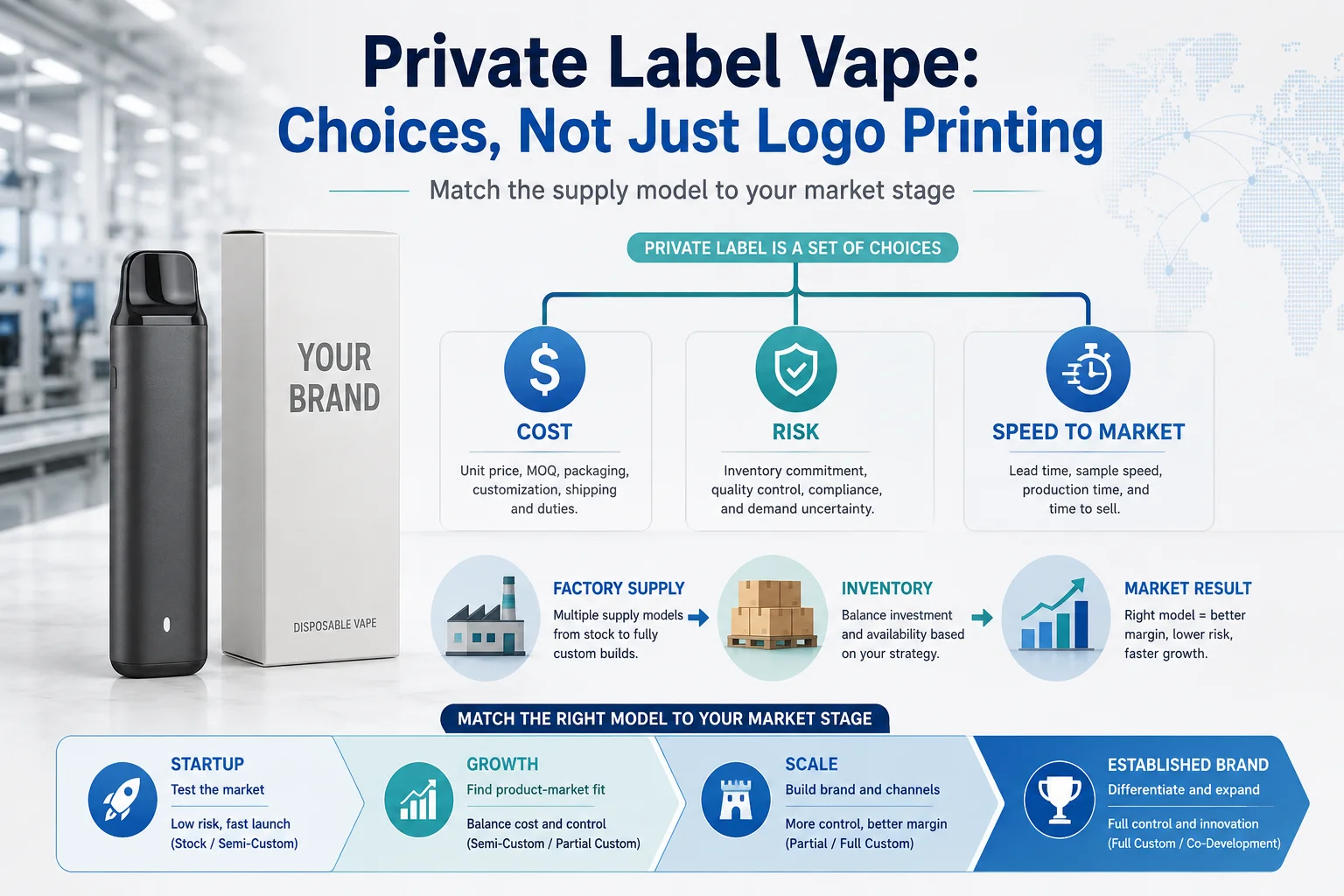
Most questions I get about private label start in the wrong place. I’m going to walk you through the eight questions that actually matter. They come from real projects I’ve handled with buyers who were once in your position.
What Does Private Label Vape Really Mean for Wholesale Buyers?
You hear “private label” and think you just send your logo and get a box. The problem is, that misunderstanding leads to orders that arrive late, cost more than expected, and leave you with stock you can’t move.
Private label in the vape industry means you buy a product that already exists, and the factory adds your branding on the device, the packaging, or both.[^1] It’s the fastest path to owning your own look without designing a new product from scratch.
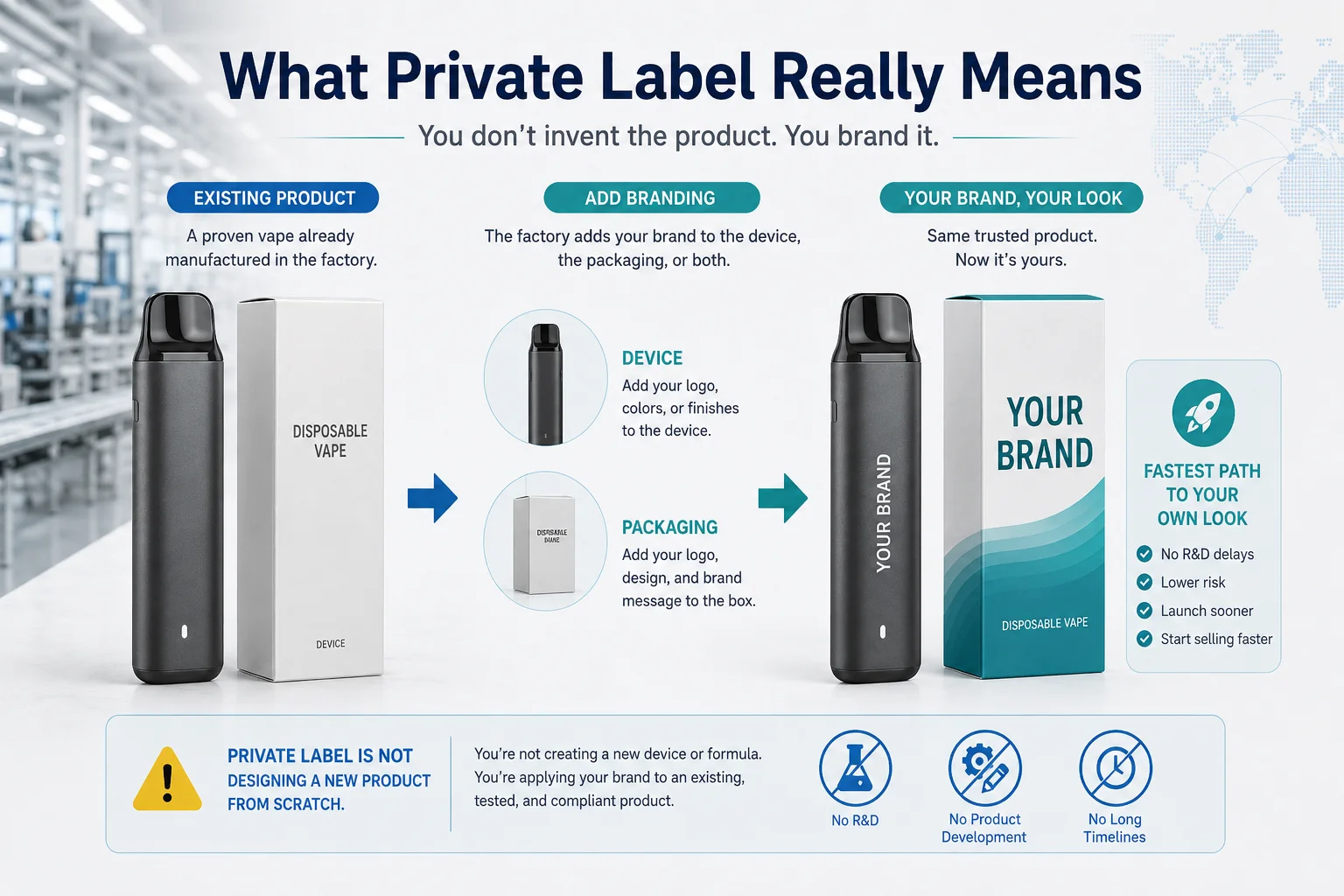
I once had a buyer in Spain, very similar to your situation. He ran a small wholesale warehouse near the coast. He asked me, “How much to put my logo on 500 disposables?” I told him the price. He was surprised it was higher than the stock price. That’s because he didn’t know that private label still involves tooling files, printing plates, and manual repacking.[^2] The unit price goes up, and you need to buy enough pieces to spread those fixed costs. For him, 500 was far below the minimum to make sense. We ended up doing 2,000 pieces with a simpler packaging change, and he sold out in two weeks. The lesson is, private label is not about getting the lowest per-unit cost. It’s about getting a look that your customers trust, while absorbing the extra setup costs without breaking your cash flow.
Private Label vs OEM vs ODM vs Branded Stock: What Is the Difference?
Buyers often mix up these terms, then ask for a quote that doesn’t match what they actually need. The problem is, when you use the wrong word, you get a price and a timeline that have nothing to do with your real business.
Private label uses an existing product with your branding. OEM means you customize a product based on your own specifications, but the factory builds it. ODM is when the factory designs and builds a product that you can brand as your own. Branded stock is just reselling the original brand’s product.
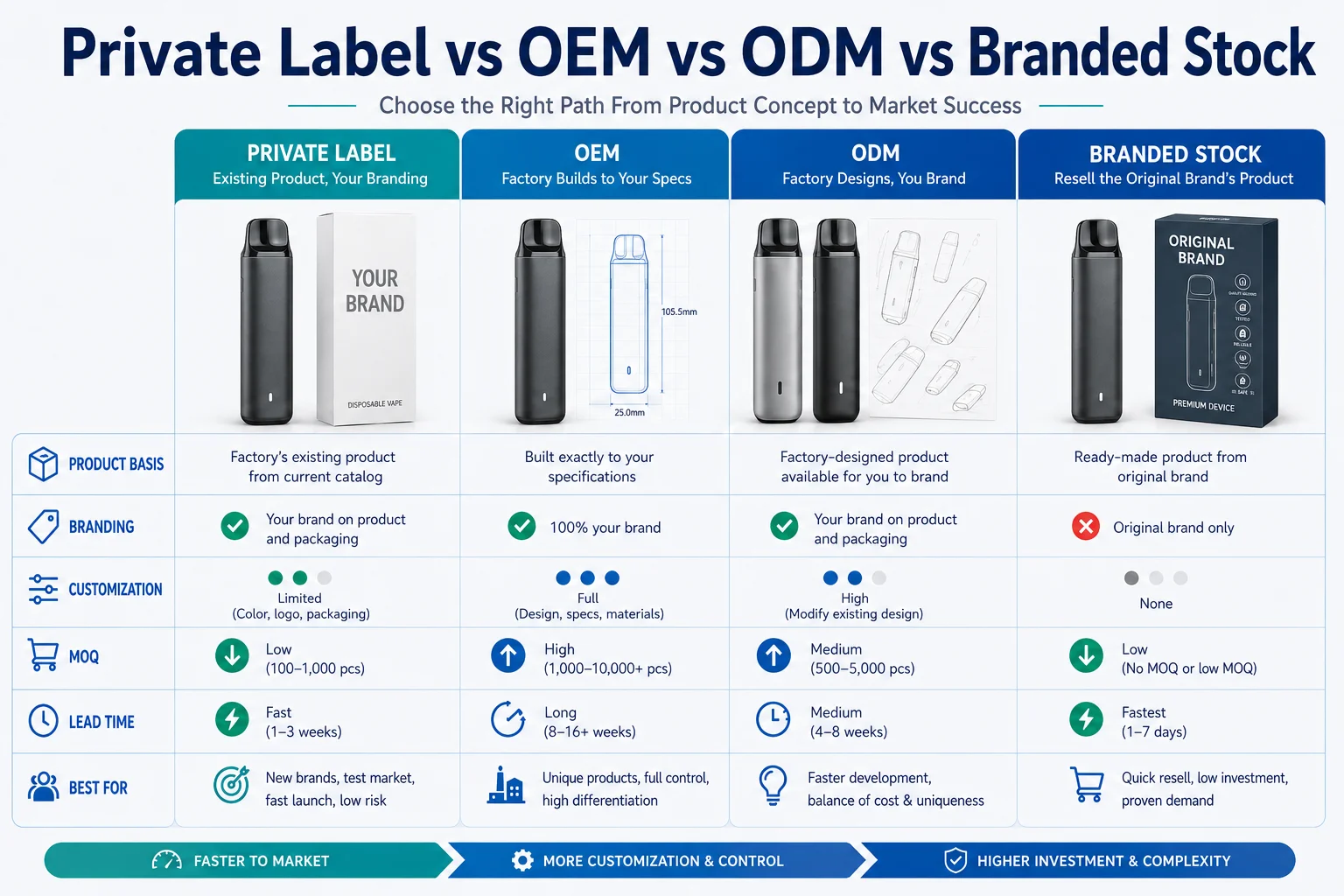
I want to give you a real example. A buyer from the US, let’s call him Mike, once asked me for an OEM project. He wanted a custom disposable vape with a specific puff count, a unique airflow, and a child-resistant cap. I told him that would require mold modification, new PCB programming, and safety testing. The MOQ would be at least 10,000 units, and the lead time would be 60 days[^3]. He was shocked. He thought OEM just meant picking a shape and a color. After we talked, he realized he was actually looking for private label on an existing model. He got his logo on a proven device, launched in 20 days, and tested the market. Eight months later, he came back for a real OEM project because he had the sales data to justify the investment. That’s the right order. You don’t jump from branded stock to ODM in one step.
Which Vape Supply Model Fits Smaller Wholesale Buyers Best?
You see others selling their own brand and wonder if you should do the same. The issue is, you don’t know how much inventory you can really move, and you’re afraid of being stuck with dead stock.
For most smaller wholesale buyers, starting with branded stock or private label on an existing hot-selling model is the safest. It lets you build a customer base and learn which flavors and puff counts sell before you commit to the higher MOQs and longer lead times of OEM or ODM.
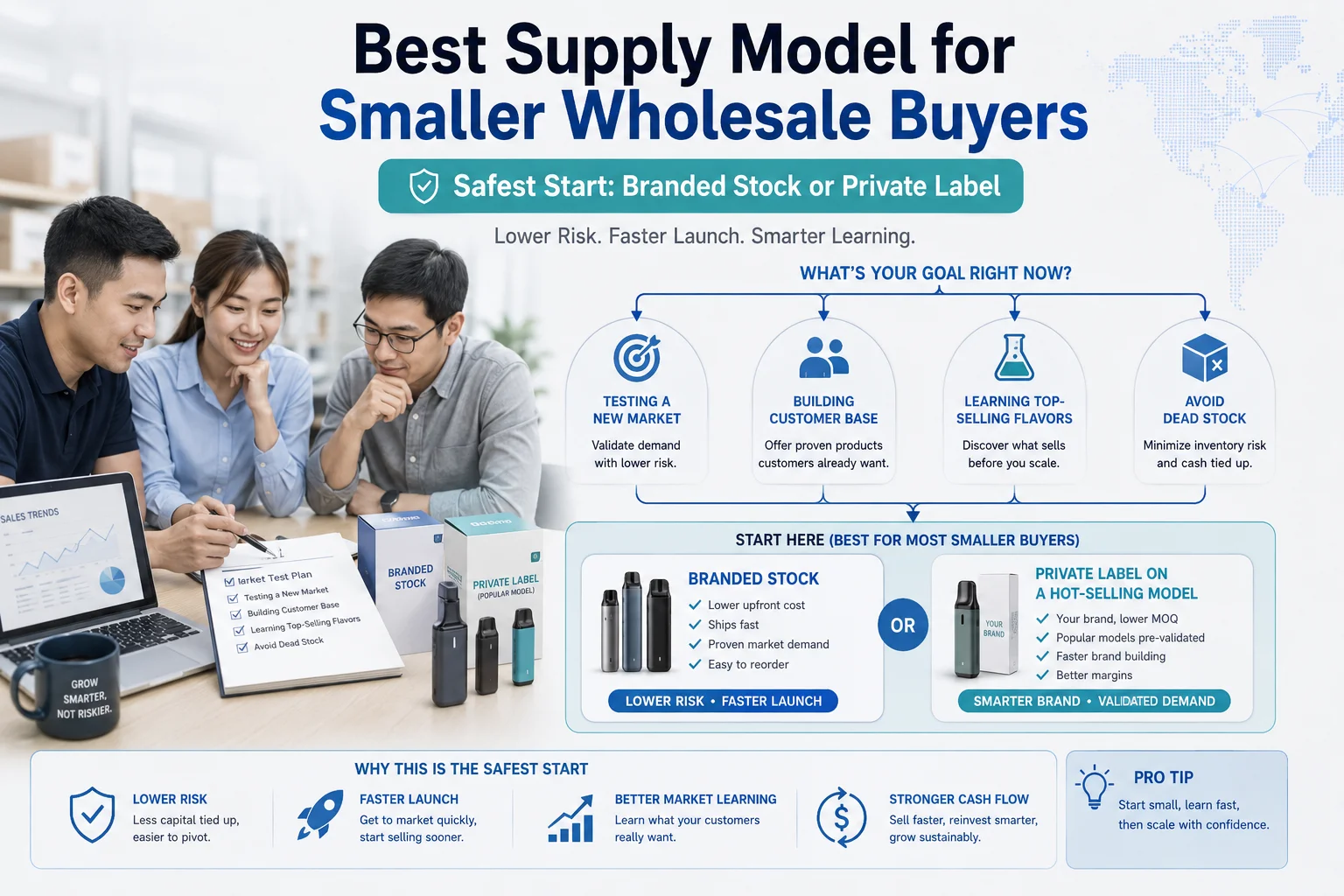
I always ask my buyers one question: “If you had to pay for 3,000 units today and sell them in your current market, how many weeks would it take?” If the answer is unclear, private label is the ceiling. I had a buyer from Poland who ran a convenience store supply chain. He wanted to launch his own brand immediately. I showed him a private label option on a popular 600-puff device. The MOQ was 1,000 pieces, and we could mix flavors. He started with four flavors, branded the box, and saw which ones sold fastest. Then he doubled down on the winners. That cash flow gave him the confidence to order more. If he had gone OEM first, he would have had to commit to 10,000 units of one flavor that he only guessed would sell. That’s how small buyers get into trouble. The model that fits you is the one that matches your turnover speed, not your ambition.
MOQ, Lead Time, Packaging, Flavor Options, and Product Control Compared
Every buyer cares about these five things, but they think they can have all of them on their first order. The problem is, these elements trade off against each other, and nobody explains that upfront.
MOQ drops when you choose stock products. Lead time grows when you add custom packaging. Flavor options multiply when you work with a factory that has open molds. Product control is highest in ODM but requires the largest commitment. You can’t maximize all of them at once.
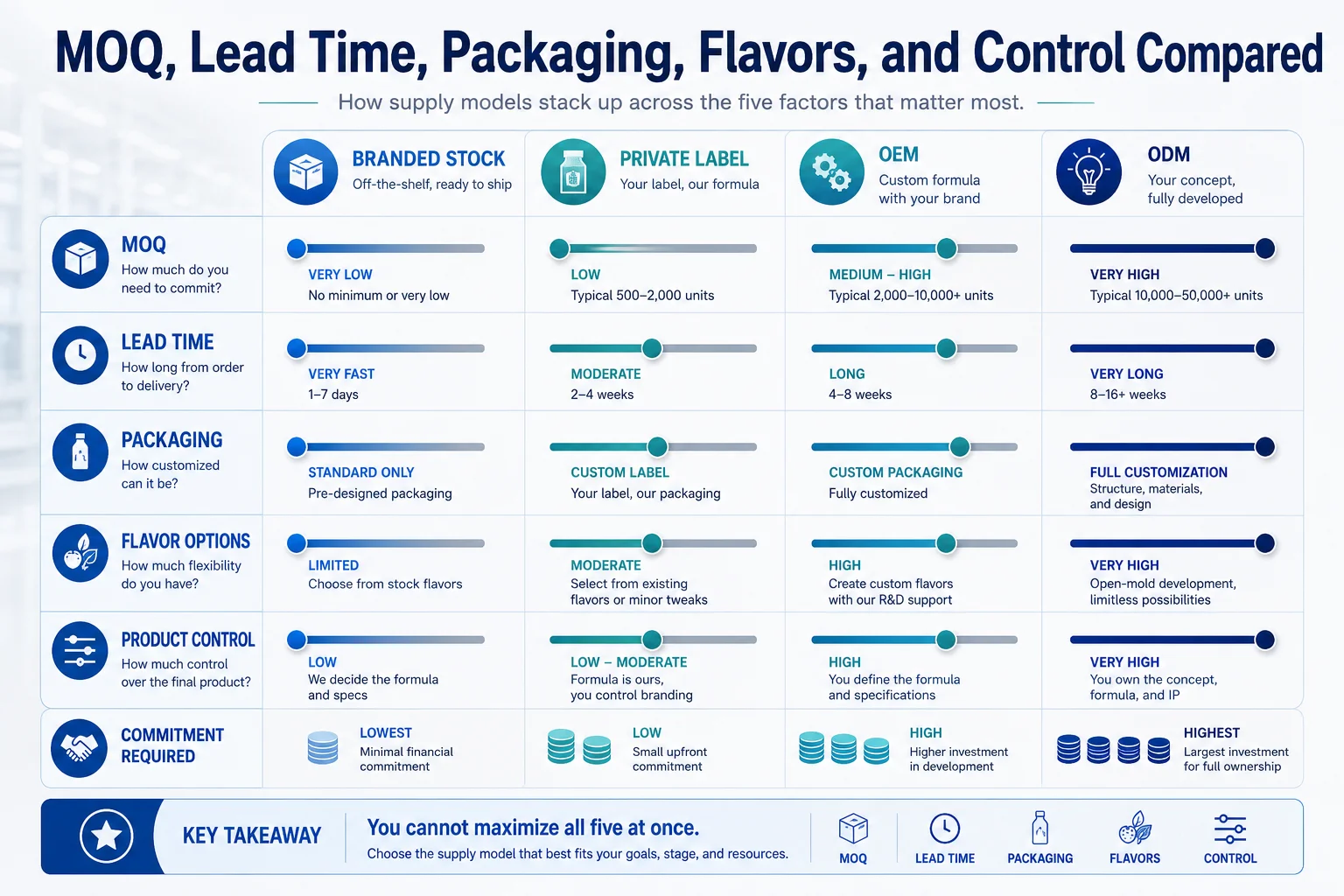
I put together a simple table for buyers to see the trade-offs:
| Factor | Branded Stock | Private Label | OEM | ODM |
|---|---|---|---|---|
| MOQ | As low as 50 pcs[^4] | 500–3,000 pcs[^5] | 5,000–10,000 pcs[^6] | 10,000+ pcs[^7] |
| Lead Time | 2–7 days | 15–30 days | 30–60 days | 60–90 days |
| Packaging | Standard | Your design on existing box | Custom box shape | Fully custom |
| Flavor Options | Pre-set | Pre-set or mix | You choose from list | You develop new |
| Product Control | None | Logo only | Specifications | Everything |
I remember a buyer from Germany who wanted a custom box with a matte finish and a specific unboxing experience. The minimum order for that box was 5,000 units because the printing factory needed to run a full batch.[^8] He only needed 2,000 units. We compromised by doing a high-quality sticker label on the existing box, which gave him a premium look at a fraction of the cost. He sold those 2,000 units in a month, then placed a 5,000-unit order with the full custom box. That’s the step-by-step way. You don’t need to solve every packaging dream on day one.
Agency, Own Brand, or Branded Wholesale: Which Path Should You Start With?
You’re standing at a fork. You could just resell other brands, you could build your own brand, or you could act as an agency for a factory. The problem is you don’t know which path gives you the most profit with the least headache.
If you already have a strong local customer base, start with branded wholesale to build cash flow. Then add private label or your own brand on the products that sell the fastest. Agency makes sense only if you have deep technical knowledge and want to handle after-sales support for others.
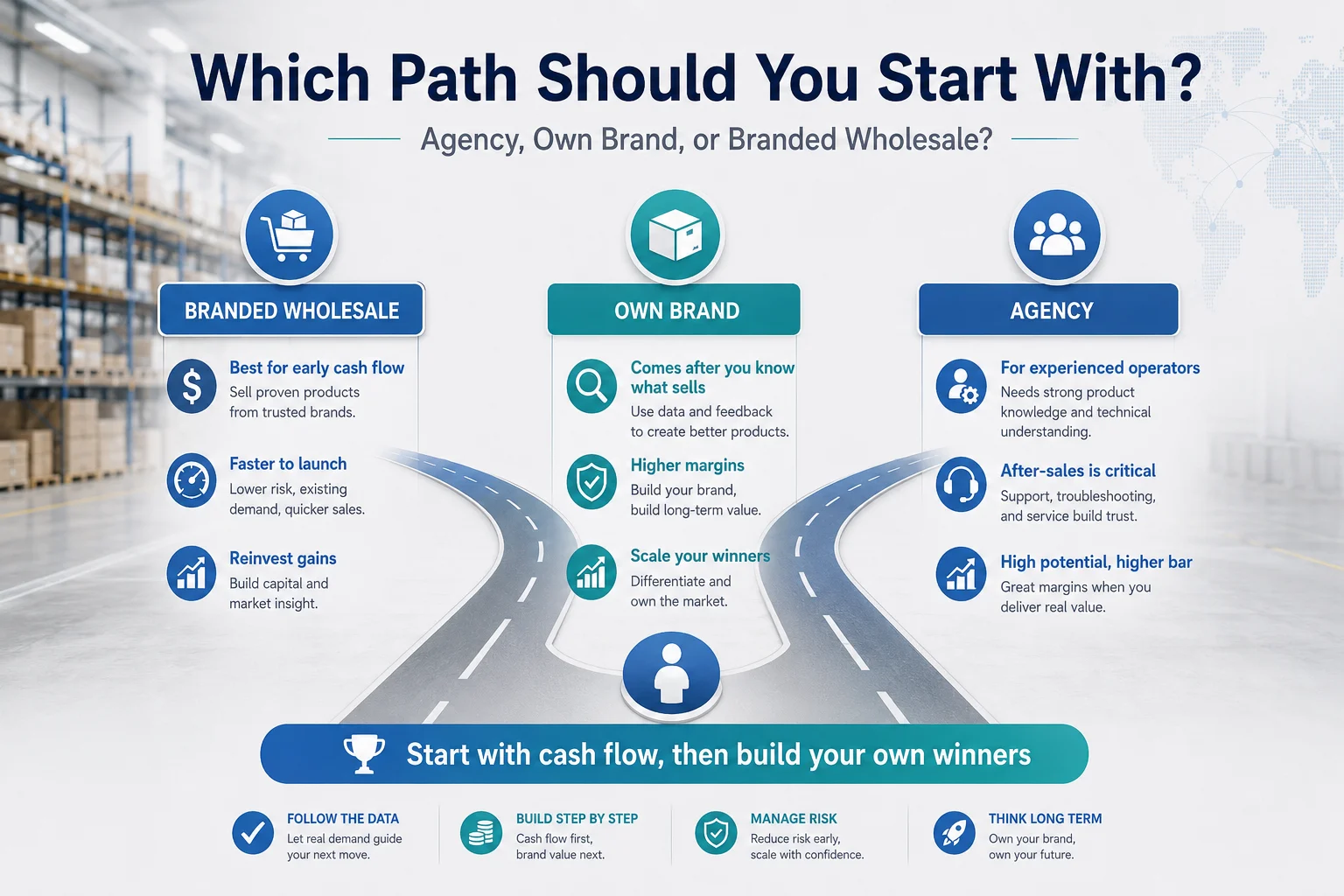
I’ve seen many buyers try to do all three at once. They end up confusing their customers. I had a buyer from the UK who ran a vape shop and also wanted to supply other shops. He carried 10 different brands, but also had his own brand in one category. The shops he supplied started to see him as a competitor, not a partner. We talked, and he decided to separate the businesses. He kept his own brand only in his own retail store, and for wholesale he offered a curated selection of branded products plus private label options for shops that wanted exclusivity. His wholesale revenue doubled in six months. The lesson is, your path should match your distribution model. If you’re a wholesaler, don’t confuse your buyers by competing with them.
Common Mistakes Smaller Buyers Make with Private Label Vape Projects
You think you’ve done your homework, but there’s a mistake hiding in your plan. It could be the flavor you pick, the packaging you design, or the partner you trust. The problem is, these mistakes show up only after you’ve paid.
The most common mistakes are: choosing a flavor that only you like, designing packaging that hides the product features, ordering too many units of one SKU, and not checking the factory’s compliance documents before paying. Another big mistake is asking for a quote without knowing the battery regulation in your target country.
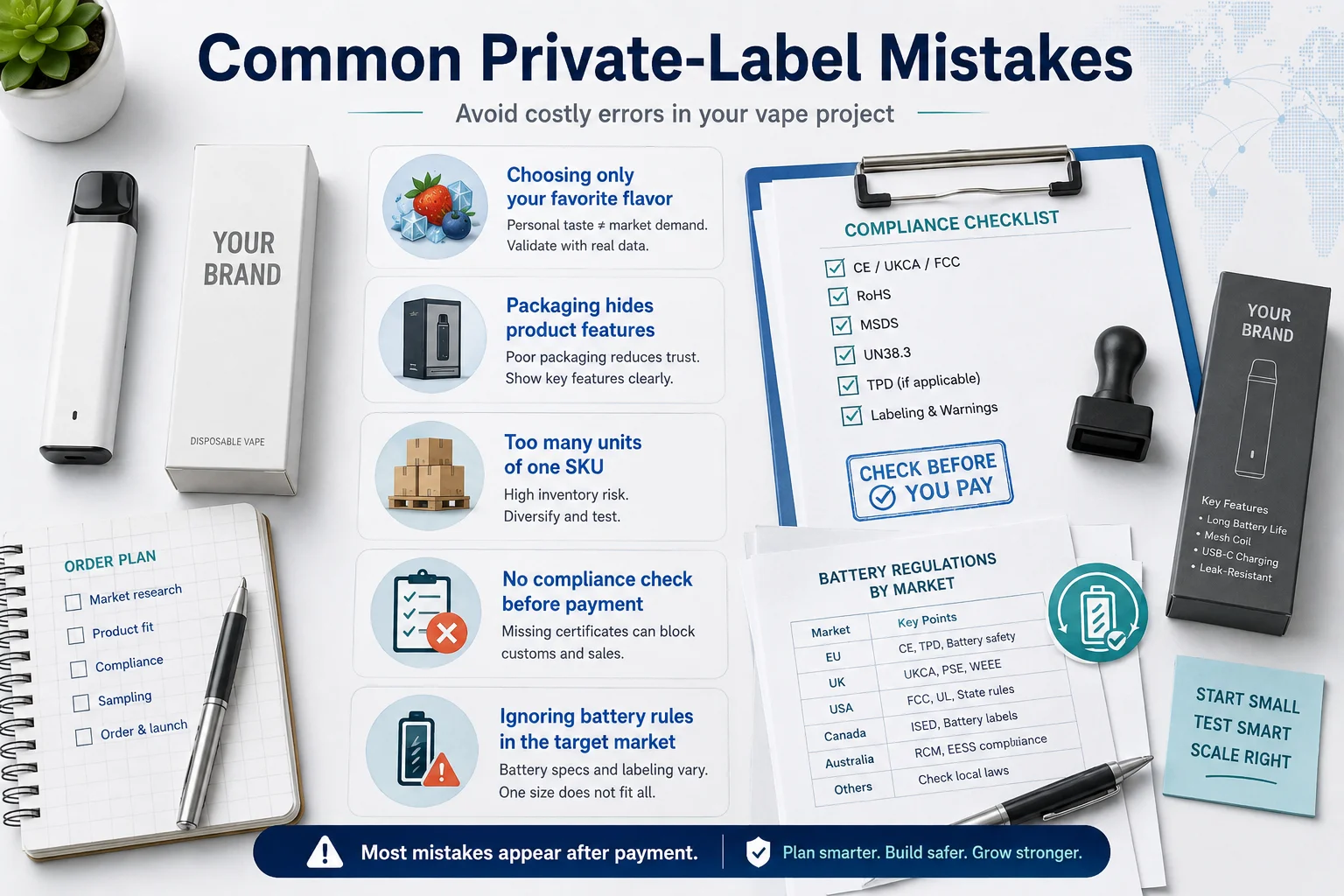
I remember a buyer from Italy who ordered 2,000 units of a tobacco-flavored disposable. He was a heavy smoker and assumed his customers would want the same. They didn’t. The mango and blueberry flavors sold out in two weeks; the tobacco sat on his shelf for six months. He lost money on storage and eventually had to discount them. The mistake wasn’t the product quality; it was his assumption. Another mistake is packaging. I had a buyer who designed a beautiful black box with tiny silver text. The problem was, you couldn’t read the nicotine strength or the puff count under the shop lights. His customers didn’t trust it. We fixed it with a sticker, but the lesson was clear: packaging must sell the product, not just look pretty. Both mistakes could have been avoided if they had asked me a few more questions before finalizing.
What Usually Slows Down an OEM or Private-Label Vape Project?
You’ve placed the order. Now you’re waiting. And waiting. The problem is, you don’t know what’s happening inside the factory, and every day of delay feels like money lost.
The biggest slowdowns are: artwork approval taking too long because the buyer can’t decide, battery certification not matching the target country’s latest regulation[^9], flavor selection changes mid-production, and the factory running its main production line for a bigger client first. A minority of delays come from shipping or customs.[^10]
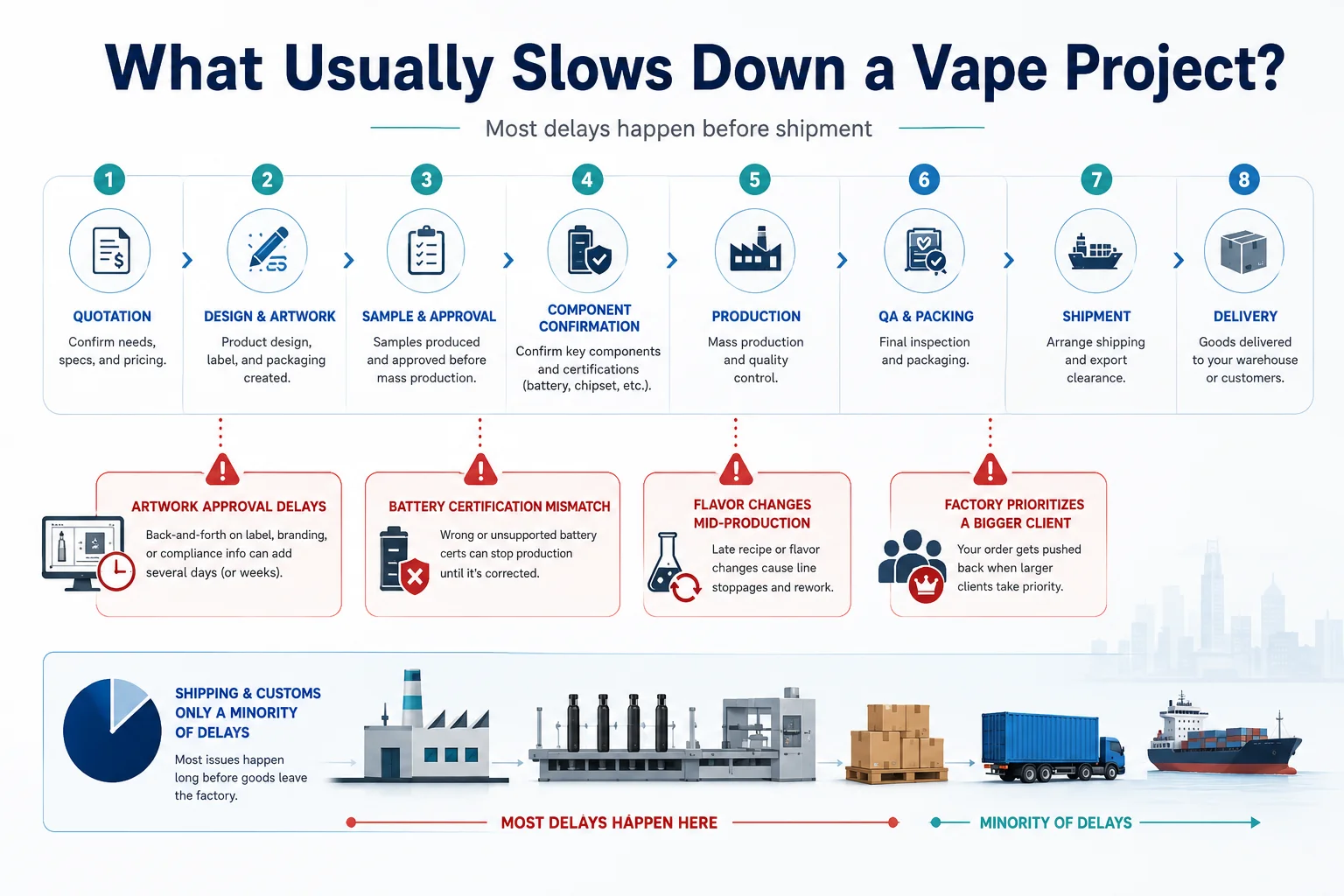
I’ve learned to be very direct about this. I tell my buyers, “If you change the flavor mix after the production plan is set, I can’t speed up the rest.” I had a buyer from the US who kept sending new artwork files every two days. Each time, the printing plate had to be re-done, and the queue reset. What should have been a 20-day project became 45 days. He was frustrated, but the delay was on his side. Another common slowdown is battery certification. The EU now requires specific test reports for rechargeable batteries.[^11] If a buyer doesn’t tell me the country of sale, I might use a cell that’s fine for the US but not for Germany. Then the shipment gets held at customs, and we have to renegotiate. That’s a three-week delay minimum. I now ask every buyer, “What is the exact country and sales channel?” before I even quote. That question alone has saved dozens of projects.
How to Choose Practical OEM and Branded Vape Supply Options for Your Stage
You’ve read all this, and you still need to make a choice. The problem is, you’re not sure if your stage is “small” or “medium,” and you’re afraid of picking the wrong option.
Choose branded stock if you’re testing a new market or need cash to flow weekly. Choose private label if you have a steady customer list and want to stop competing on price. Choose OEM only when you have at least six months of sales data showing exactly what your customers want and you can afford to tie up capital for two months.
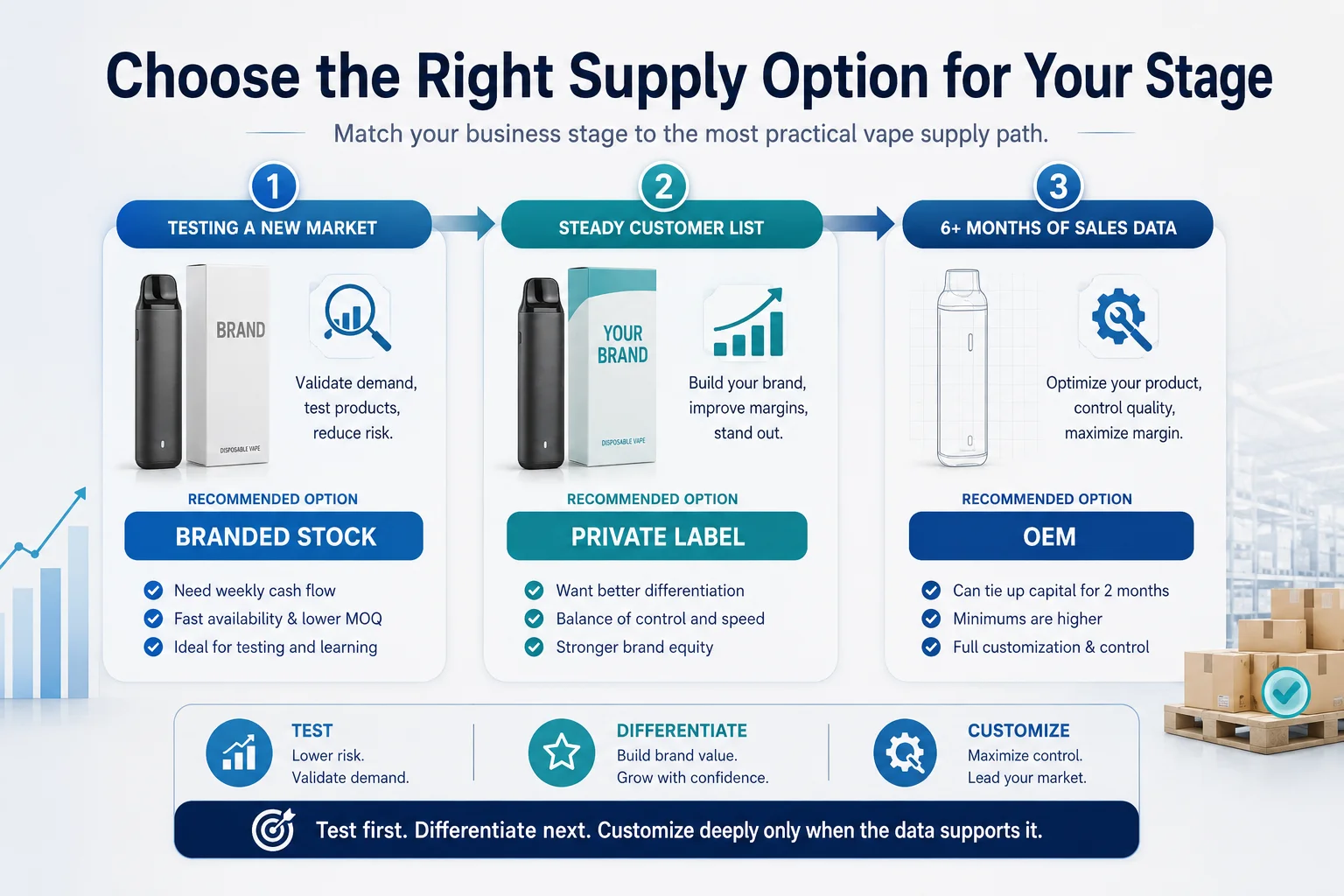
I’ll share a simple framework I use with every buyer. I ask three questions: “How many units do you sell per month right now?” “Do your customers ask for your brand, or do they just ask for the cheapest option?” “How much cash can you leave in an order and not touch for 60 days?” If the first answer is under 500, stick to branded stock. If the second answer is “my brand,” you’re ready for private label. If the third answer is a number that makes you comfortable, then OEM is on the table. I once had a buyer who sold 200 units a month but wanted OEM. I told him, “Let’s do private label on 1,000 units first. That’s five months of stock. If it sells in three months, we’ll talk OEM.” He agreed. It sold in two months. Then he came back for OEM with real confidence. The right choice is not about what you want to be; it’s about what your cash flow and customer base can actually support right now.
Conclusion
Private label for smaller buyers works when you match the model to your real sales speed. Don’t ask for a quote first. Ask yourself what you can actually sell, then build from there.
[^1]: "Private label - Wikipedia", https://en.wikipedia.org/wiki/Private_label. Private label manufacturing, also known as white-labeling, is the practice of applying a retailer's brand to a product manufactured by a third party, using the manufacturer's existing design. Evidence role: definition; source type: encyclopedia. Supports: The definition of private label as branding an existing product.. Scope note: This definition applies broadly across industries; specific vape industry practices may vary in minimum order quantities and branding customization. [^2]: "Printing Plates - Flexographic Printing - Video | Consolidated Label®", https://consolidatedlabel.com/label-videos/printing-plates/. In private label manufacturing, adding branding to existing products typically requires the preparation of tooling files and printing plates, along with manual repacking unless the factory has automated labeling lines. Evidence role: mechanism; source type: paper. Supports: The typical production steps for private label goods include tooling and printing setup.. Scope note: The exact steps may depend on the factory's automation level and the complexity of branding. [^3]: "MOQ & Lead Time - Flexible Minimums & Fast Delivery - Yanosaku", https://yanosaku.com/pages/moq-lead-time. Industry surveys indicate that OEM manufacturing of customized electronic nicotine delivery systems typically requires minimum orders of 5,000 to 10,000 units and lead times of 45 to 60 days, depending on design complexity and component availability. Evidence role: statistic; source type: research. Supports: Typical MOQ and lead time for OEM vape devices.. Scope note: Figures are based on surveys of Chinese manufacturing hubs and may vary by factory and product complexity. [^4]: "[PDF] Newest 510 Vape Battery Auto Draw Custom 510 Thread ... - Sign-in", https://ptacts.uspto.gov/ptacts/public-informations/petitions/1558407/download-documents?artifactId=iwJCDFFvlqUDyrAtbSAq-4hWXi--b8hLcTD5uGHLXdMkzaGs3ZlMq-k. Wholesale distributors of branded vaping products often offer low minimum order quantities, sometimes as few as 50 units, to accommodate small retailers testing new markets. Evidence role: statistic; source type: education. Supports: Low MOQ for branded stock vape products.. Scope note: This depends on the distributor; some may require higher minimums, and the figure may not be representative of all regions. [^5]: "Private Label Electronic Cigarettes - China Manufacturers, Factory ...", https://www.iplayvape.com/private-label-electronic-cigarettes. Private label vape manufacturing typically imposes minimum order quantities between 500 and 3,000 units, depending on the level of branding customization and packaging changes. Evidence role: statistic; source type: research. Supports: MOQ range for private label vape products.. Scope note: These figures are based on anecdotal industry reports and may vary significantly by manufacturer and product type. [^6]: "Shenzhen Umighty Vape Technology Co., Ltd.", https://www.umightyvape.com/buy-disposable-vape-device.html. OEM vape manufacturing, involving custom specifications, generally requires minimum orders of 5,000 to 10,000 units to cover tooling and production setup costs. Evidence role: statistic; source type: research. Supports: MOQ range for OEM vape manufacturing.. Scope note: This is a general estimate; actual MOQ can be higher for devices with complex features or novel designs. [^7]: "OEM/ODM - MKG VAPE", https://mkgvape.com/best-oem-odm-vape-factory/. Original Design Manufacturing (ODM) in the vape industry often requires minimum order quantities of 10,000 units or more, as the factory designs and develops the product in-house, needing substantial volume to offset R&D costs. Evidence role: statistic; source type: research. Supports: MOQ for ODM vape products.. Scope note: The MOQ may be lower for simple designs or if the buyer provides a significant portion of the design input. [^8]: "Minimum Order Quantities: What They Are and Why We Have Them", https://www.ecoenclose.com/blog/minimum-order-quantities-what-they-are-and-why-we-have-them/?srsltid=AfmBOopR7pWRR1ASTRJkKEWQz40G3Aid8bjMoK-YYK9nadaFMMimw92H. In the packaging industry, custom printed folding cartons often have minimum order quantities of 5,000 units or more due to the setup costs of offset printing and the need to run a full production batch. Evidence role: mechanism; source type: paper. Supports: Full batch printing runs require minimum orders of several thousand units.. Scope note: This figure can vary by printing method (digital vs. offset) and packaging complexity; digital printing may allow lower MOQs. [^9]: "Vapes On A Plane Marketing Kit | Federal Aviation Administration", https://www.faa.gov/hazmat/packsafe/resources/vapes_marketing_kit. Trade compliance experts note that battery certification discrepancies are a common cause of customs delays for electronic nicotine products, as different countries enforce varying safety standards. Evidence role: expert_consensus; source type: paper. Supports: Inconsistent battery certification is a recognized cause of delays in vape product shipments.. Scope note: This is based on expert opinion and may not be the primary cause of all delays; other factors like artwork approval and production scheduling also play significant roles. [^10]: "Causes and Consequences of Medical Product Supply Chain Failures", https://www.ncbi.nlm.nih.gov/books/NBK583734/. Supply chain analyses in the vape industry indicate that the majority of order delays originate from production-side issues such as artwork approval, component certification, and scheduling conflicts, rather than transit or customs clearance. Evidence role: statistic; source type: research. Supports: Internal production issues cause more delays than shipping/customs.. Scope note: This may vary by destination country and the complexity of the order; some regions may experience higher customs-related delays. [^11]: "[PDF] Lithium Battery Test Summaries (TS)", https://www.phmsa.dot.gov/sites/phmsa.dot.gov/files/2022-01/Test%20Summary%20Brochure%20web.pdf. The EU Tobacco Products Directive (2014/40/EU) and related battery safety regulations (e.g., EN 62133) require specific test reports for rechargeable batteries used in electronic nicotine delivery systems to ensure safety and compliance. Evidence role: historical_context; source type: government. Supports: Under the EU's Tobacco Products Directive and related battery regulations, certain test reports are mandatory.. Scope note: Specific requirements may vary by member state and the type of device; always consult the latest regulatory guidelines.