
Are you excited to start wholesaling vapes but worried about picking the wrong brand? You don't want to get stuck with products that don't sell or just bring you headaches.
The safest way to test a new vape brand is by placing a small, low-risk trial order from a reliable supplier's overseas warehouse. This lets you check product quality, customer feedback, and sales speed before you commit to a large, direct-from-China shipment.
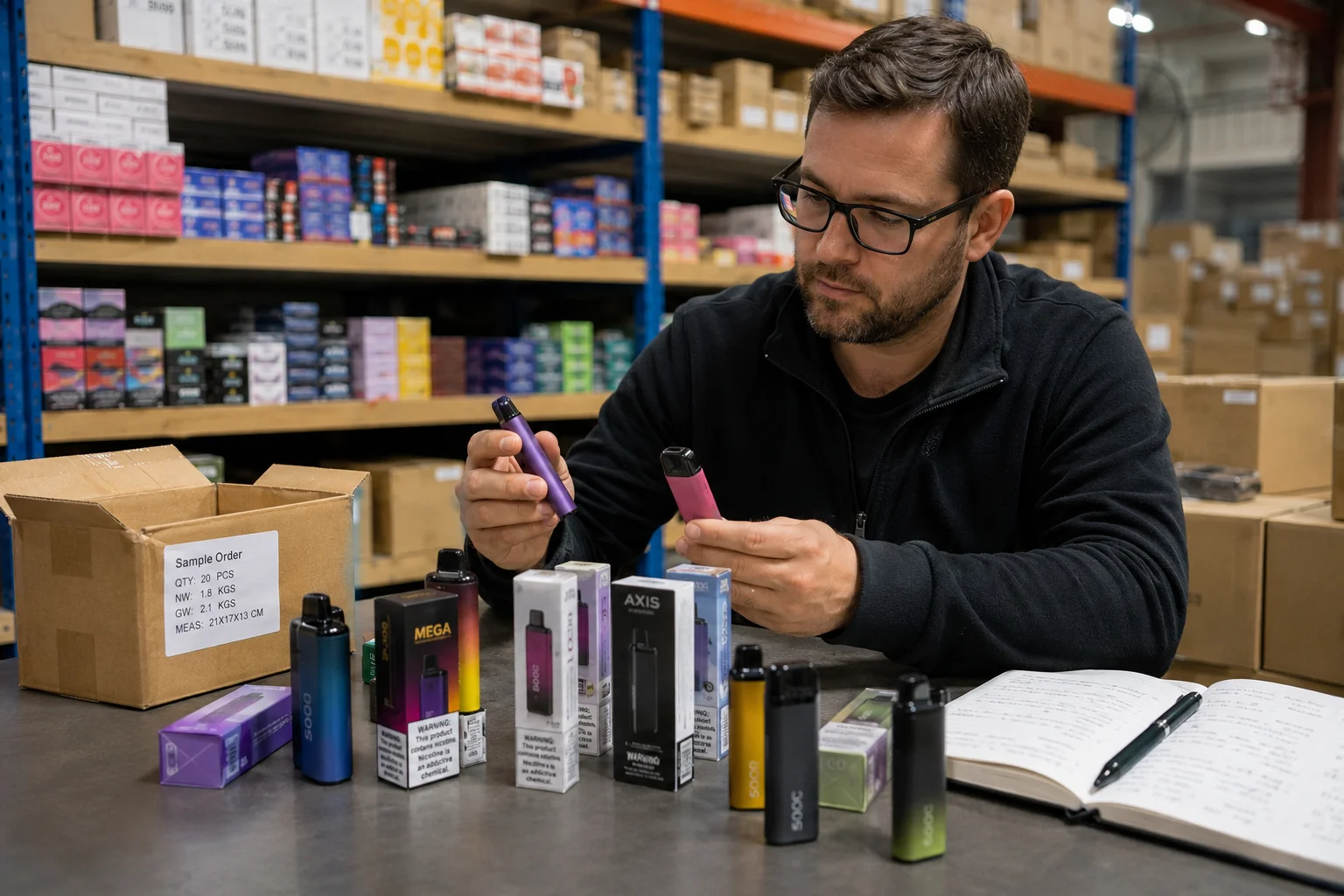
I've been in the export business for over 15 years. I talk to buyers like you every single day. I've seen people make some very costly mistakes, and I've also seen small sellers grow into huge distributors. The difference often comes down to how they start. Let's talk about how you can avoid the common traps and build a profitable business, one smart step at a time.
Which product lines are safer for a first wholesale order?
Are you feeling overwhelmed by the thousands of vape models out there? Choosing the wrong one for your first order can tie up your cash and kill your momentum before you even start.
For your first order, stick with well-known, high-demand brands like ELF BAR or VOZOL. These brands already have market recognition, which makes them much easier to sell. Avoid obscure or extremely cheap brands, as they often come with quality issues and higher risks[^1].
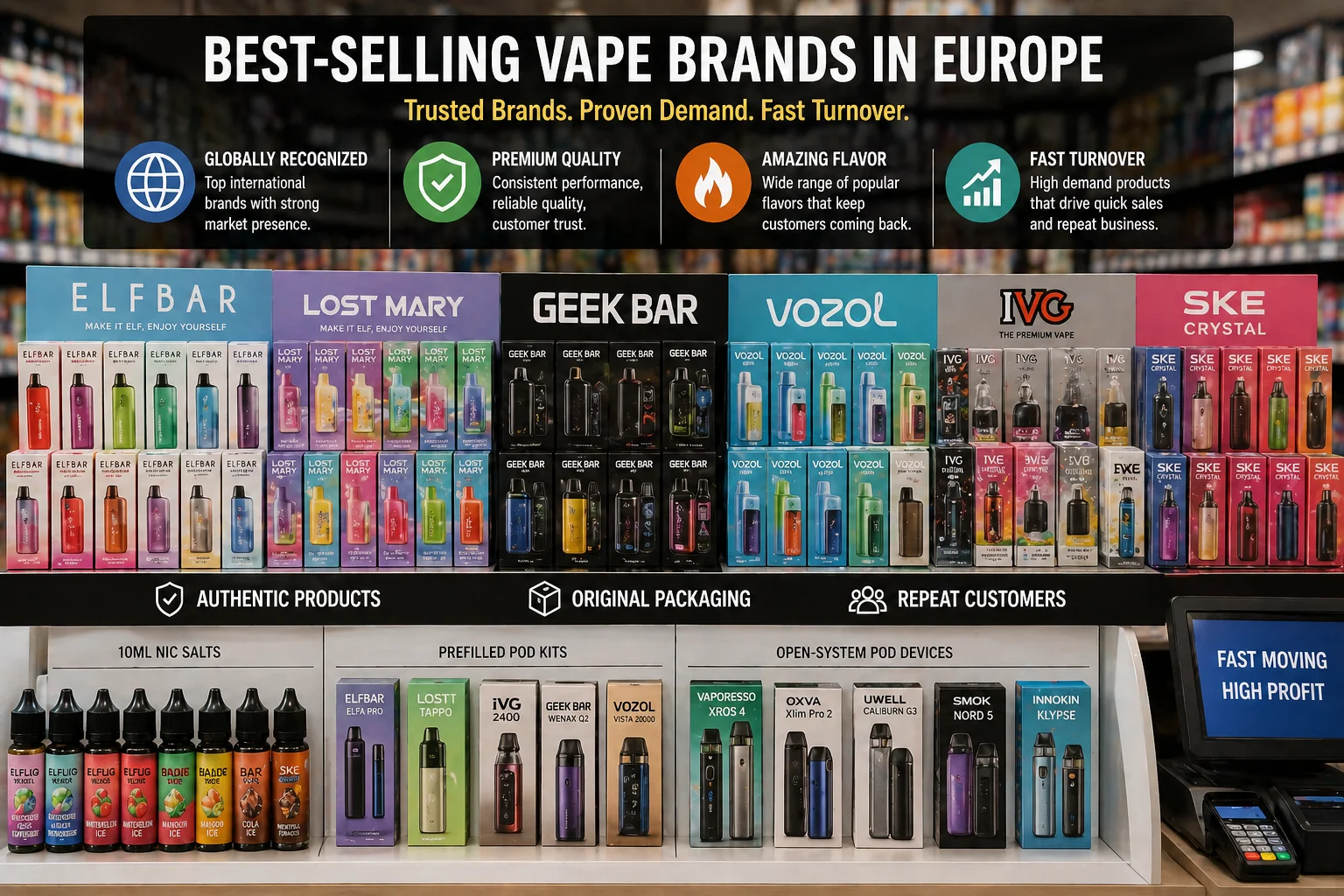
When you're just starting, your goal is to get a quick win. You need to sell products fast to get your money back and build confidence. That's why picking the right brand is so important.
Why Established Brands are a Safer Bet
Top brands like ELF BAR and VOZOL spend a lot of money on quality control and marketing. Customers already know them and trust them. When they see it in your store or on your website, they are more likely to buy. This means less work for you in convincing them. In contrast, an unknown brand, even if it's cheap, requires you to educate the customer. You have to explain what it is and why they should buy it. That's a much harder sell.
A Word on Super-Popular Brands
Now, you might hear about brands like GEEK BAR or RAZZ BAR. These are also top-tier. But here’s a tip from inside the industry: many of these giant brands operate on an exclusive distributor model[^2]. They might only work with one huge partner in an entire country. They require massive monthly orders, sometimes a million units. For them, a few thousand pieces is nothing. So, unless you are a major player, it can be hard to get stock directly. Don't waste months chasing a brand that won't sell to you. Focus on popular brands that are accessible through reliable wholesalers.
Here’s a simple way to think about it:
| Brand Type | Your Risk | Sales Effort | Best For |
|---|---|---|---|
| Top-Tier (e.g., ELF BAR) | Low | Low | Beginners & Veterans |
| Budget (e.g., Bang King) | Medium | Medium | Price-sensitive markets |
| Unknown/Cheap | High | High | Not recommended for starting |
How can I compare two brands without relying only on price?
You see two vapes that look almost identical. One costs 4 euros, the other costs 2 euros. Is it a bargain or a trap? Choosing based on price alone can lead to terrible quality.
Look past the price and check the two things that really matter: the battery and the e-liquid. Quality brands use stable lithium batteries[^3] and premium e-liquid. This gives you consistent performance and taste. Cheap knock-offs always cut corners here, which causes problems.
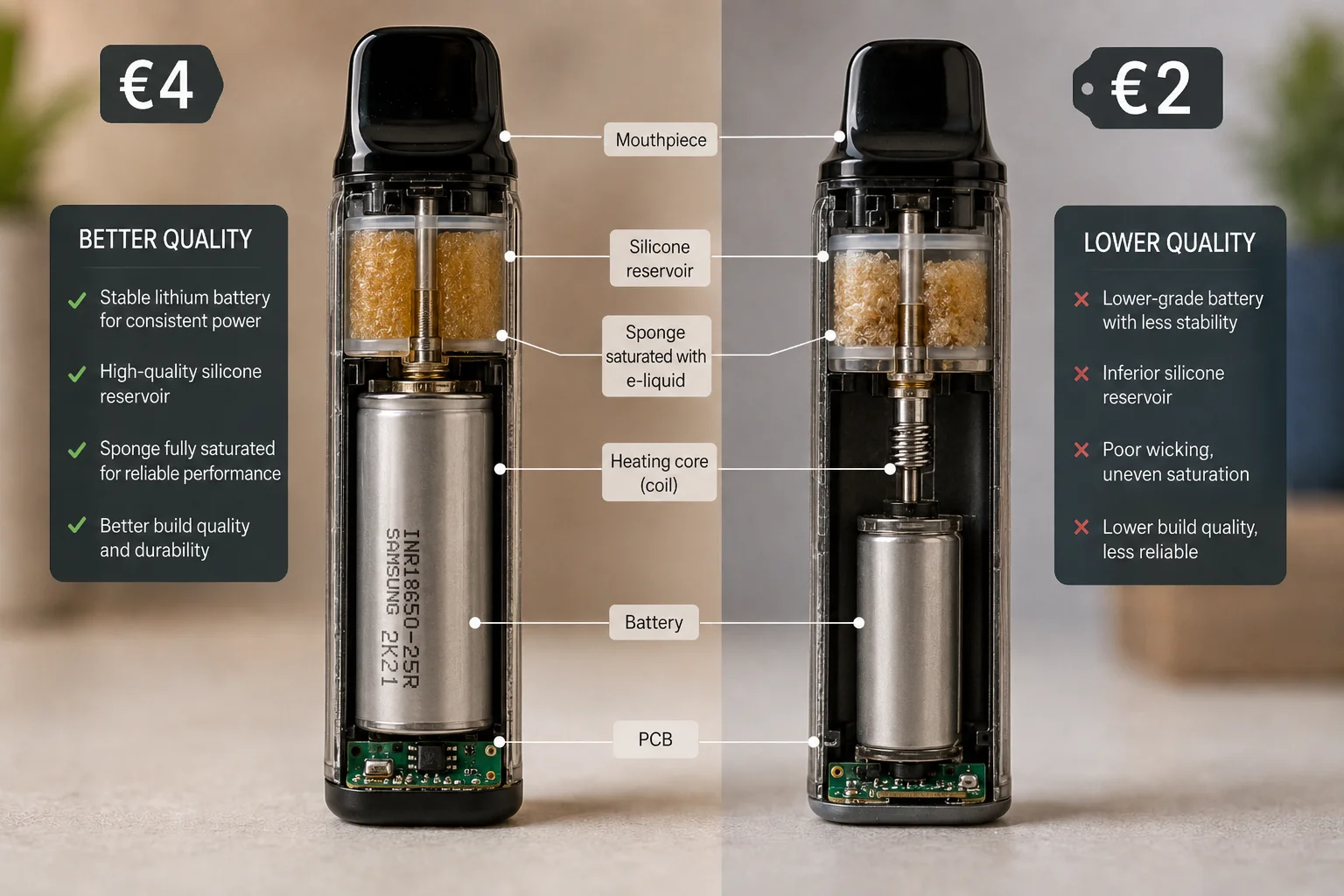
A common question I get is, "Why is your product more expensive than this other one?" It's a fair question. But the real question should be, "What am I getting for my money?" A disposable vape is not just a plastic tube. It’s a mini-machine.
The Battery Makes a Huge Difference
The biggest cost, and the biggest difference, is the battery.
- Good Vapes: They use quality rechargeable lithium batteries. These batteries hold a charge well, deliver consistent power, and even work when it's cold outside. You get a good puff from the first to the last.
- Cheap Vapes: They use the cheapest cells they can find, often manganese or low-grade cobalt[^4]. What does this mean for you? The vape might die after just a few puffs. It might stop working in cold weather[^5]. You charge it for hours, and it only lasts five minutes. This is what leads to customer complaints.
The E-liquid Determines the Experience
The second key part is the e-liquid. This is what your customer inhales.
- Good Vapes: The e-liquid comes from reputable suppliers. The flavors are consistent, the nicotine level is accurate, and it's made in a clean environment.
- Cheap Vapes: The e-liquid is a complete mystery. It could be mixed in a dirty workshop[^6]. The flavor might taste burnt or just weird. One batch might be okay, but the next is terrible. This is a health risk and a business risk. You lose customer trust instantly.
Remember, when you sell a product, you are also selling your reputation. Saving one or two euros on a cheap product isn't worth it if you get a flood of returns and lose customers forever.
What are the most common mistakes and misleading assumptions?
Do you think the vape with the highest puff count is the best seller? Or that the cheapest product will make you the most profit? These ideas sound logical, but they can lose you money.
The biggest mistake is chasing the lowest price, which often leads to fake products[^7]. Another is believing high puff counts are real; they are mostly a marketing game. Real profit comes from quality, customer satisfaction, and fast sales, not just a low purchase price.
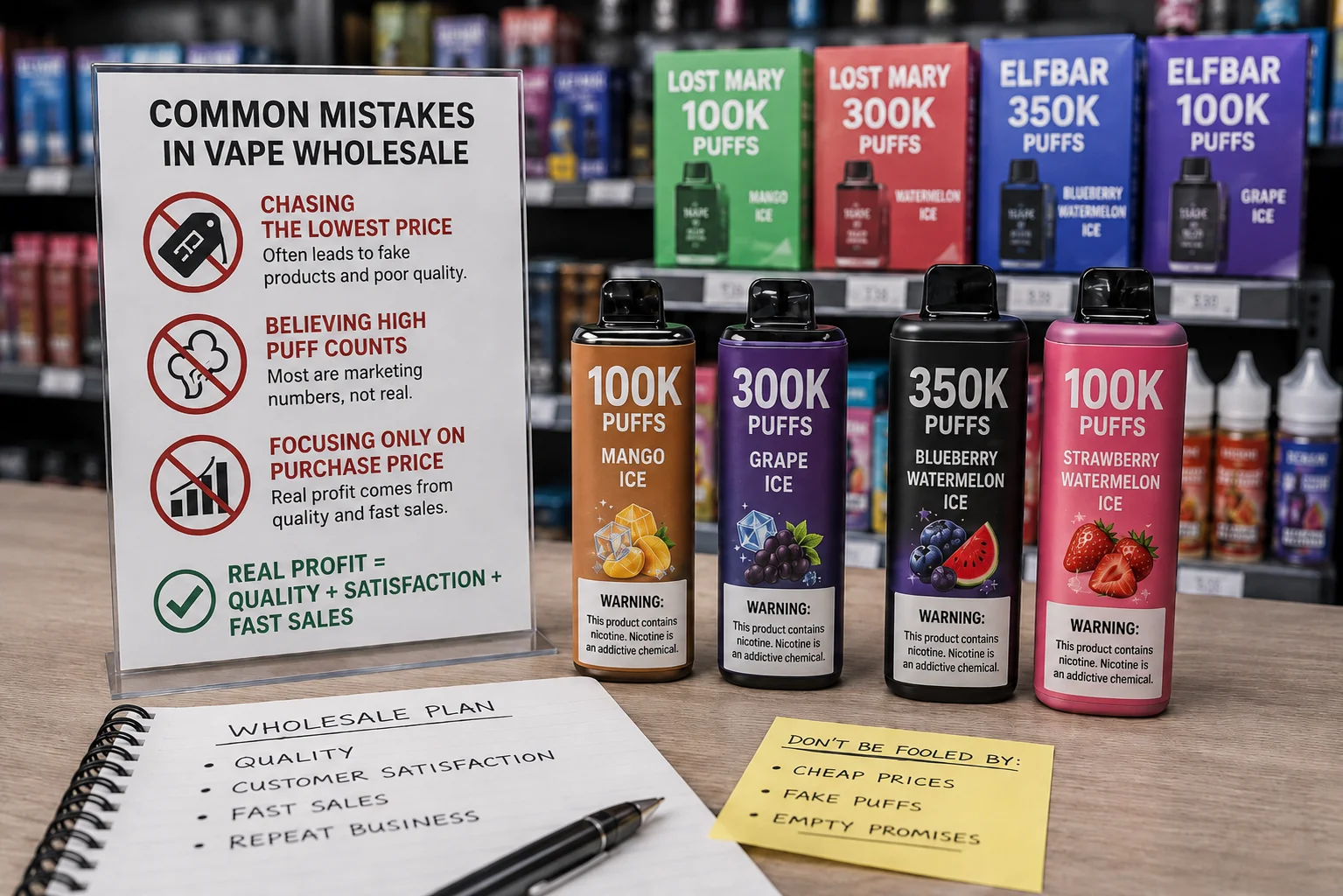
Let's break down two of the most dangerous myths I see new wholesalers fall for. If you can avoid these, you're already ahead of most of the competition.
Myth 1: "Cheaper is Better"
If the cheapest things were the most profitable, we’d all be selling plastic bags. The truth is, the price you buy at is only one part of the equation. The most important factor in business is the speed of your money. It's called capital turnover[^8].
Let me explain.
- Scenario A: You buy a quality vape for €5 and sell it for €6. You make €1 profit (20%). But because it's a good product, you sell your whole stock in one week.
- Scenario B: You buy a cheap vape for €2 and sell it for €3. You also make €1 profit (50%). But it's a bad product. It takes you three months to sell it, and you get lots of complaints.
In Scenario A, you can reinvest your money every week. In a month, you've made a €4 profit on your original €5 investment. In Scenario B, you've only made €1 profit in three months. The fast-selling, quality product is much more profitable. Business is about how many times you can make your money work for you, not how much you make on a single sale.
Myth 2: "More Puffs are Better"
Lately, the market has gone crazy with puff counts. 50,000 puffs, 100,000 puffs, I've even seen 300,000. This is just a numbers game. It's not real.
A disposable vape has physical limits. It can only hold so much e-liquid and so big a battery. Here's a simple rule of thumb: 1 ml of e-liquid gives you about 200 puffs[^9].
Even the largest disposable vapes on the market hold about 50 ml of liquid. So, the real maximum puff count is around 10,000 puffs[^10] (50 x 200). Anything advertised above that is pure marketing. The internal heating coil also wears out[^11]. After about 10,000 puffs, the flavor will taste burnt anyway, even if there's liquid left.
So, stop looking at the crazy puff numbers on the box. Instead, look for the e-liquid capacity in milliliters (ml). That's the real indicator of how long the vape will last.
How do I place a lower-risk trial order to get started?
Are you ready to place an order but scared of customs, high MOQs, and long shipping times from China? A big first order can feel like a huge gamble. There is a much better way.
For orders under 2,000 units, use a supplier's local warehouse. For our EU clients, we use our Germany warehouse. You get low MOQs (as low as 50 units), fast shipping (1-5 days), and zero customs risk. It's the perfect way to test the market.
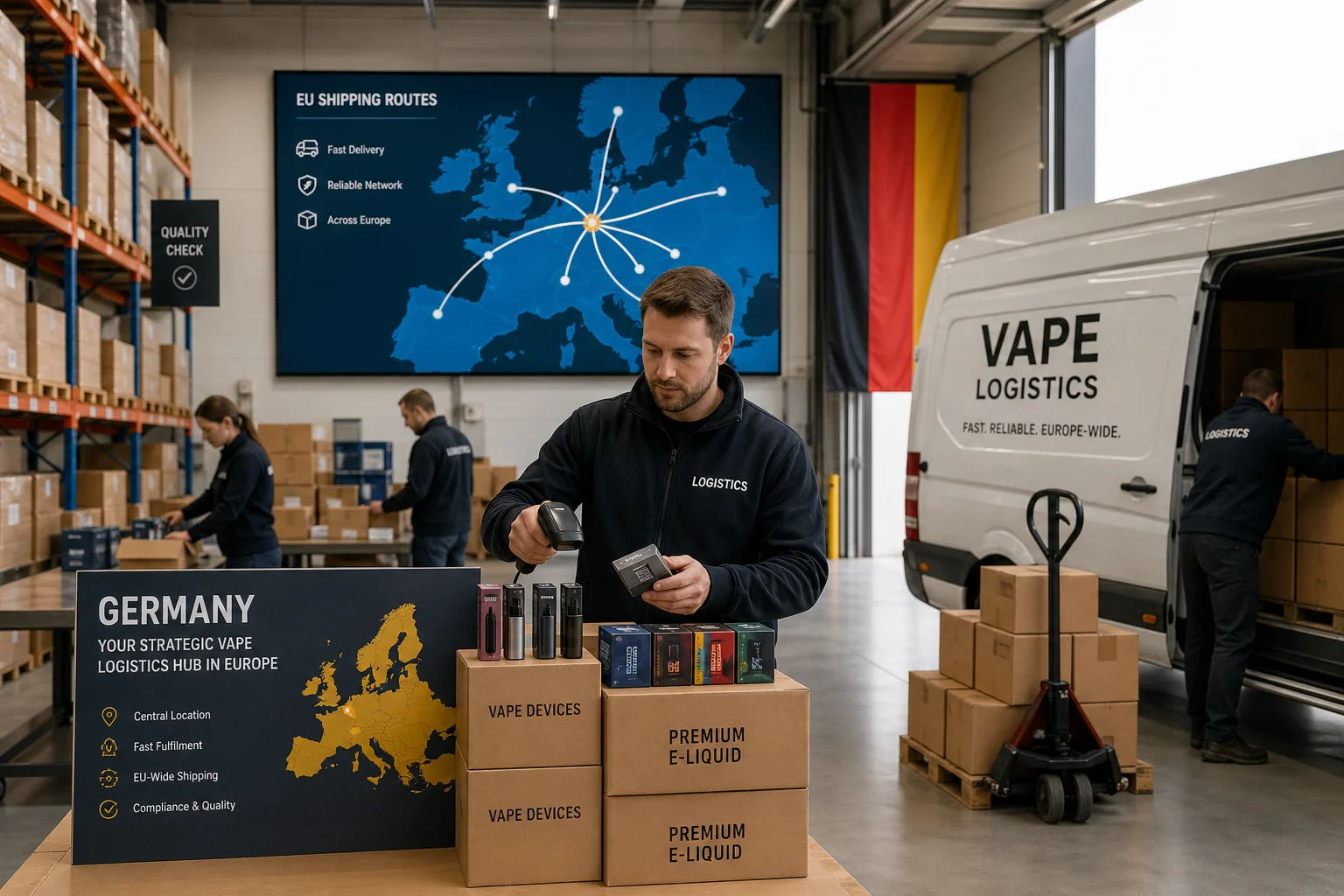
As a wholesaler, you have two main options for buying stock. The right choice depends on the size of your business.
Path 1: For New and Small Wholesalers
If you are just starting or your orders are small, using an overseas warehouse is a no-brainer. We set up our warehouse in Germany specifically to help clients like you. Here’s why it works so well:
- Low Startup Cost: You can start with an order as small as 50 units. This means you can start your business for less than 400 euros. The risk is very low.
- Fast Delivery: We ship with DHL from Germany. You get your products in 1-2 days if you're in Germany, and 3-5 days for the rest of the EU.
- No Customs Hassle: We handled the difficult part of importing the goods from China to Europe. You don't have to worry about customs seizing your shipment[^12]. The risk is on us.
- Test and Learn: You can buy a few different models and see what sells best in your market. Once you know what your customers want, you can order more.
Path 2: For Larger, Experienced Wholesalers
If you are ordering more than 2,000 units at a time and are sensitive to price, ordering directly from China makes sense.
- Better Prices: You get a lower unit cost because you're buying in bulk.
- More Choice: You have access to a wider range of products and the latest models.
However, this path comes with more responsibility. You have to deal with longer shipping times and the risk of customs seizure. Here's a crucial tip: Always buy full customs insurance. It costs a little extra per kilogram, but it's worth it. If your shipment gets seized, the insurance company or supplier will send you a new one for free.
Also, be aware of countries with "secondary clearance" like Denmark, Sweden, and Romania. Insurance often doesn't cover seizures in these countries after the goods have already entered the EU. In these cases, it's safer to ship to a neighboring country (like Germany) and arrange transport yourself.
Conclusion
To test a new brand, start small with a trusted supplier's local stock. Focus on quality and how fast it sells, not just the purchase price, to build a truly profitable business.
[^1]: "E-Cigarette Quality Control: Impurity and Nicotine Level Analysis in ...", https://pmc.ncbi.nlm.nih.gov/articles/PMC7174940/. Studies and public health warnings have documented that cheap, often counterfeit, e-cigarettes can pose significant risks, including poor manufacturing quality, the presence of harmful contaminants, and inconsistent nicotine levels. Evidence role: general_support; source type: government. Supports: The link between low-cost, illicit, or unbranded vape products and a higher incidence of manufacturing defects, inaccurate labeling, and potential health risks.. [^2]: "Exclusive Distribution Agreement between the Registrant ... - SEC.gov", https://www.sec.gov/Archives/edgar/data/1376231/000121390024001269/ea191186ex10-1_vprbrands.htm. Major brands in regulated, high-volume industries often utilize an exclusive distributor model, granting rights to a single large entity within a specific region to manage logistics, marketing, and sales, which can limit access for smaller retailers. Evidence role: case_reference; source type: other. Supports: The use of exclusive distribution agreements as a common strategy for major brands in the consumer electronics and vape industries to control supply chains and brand image.. Scope note: The source may discuss this as a general business strategy rather than naming the specific vape brands mentioned. [^3]: "Lithium-Ion Battery - Clean Energy Institute - University of Washington", https://www.cei.washington.edu/research/energy-storage/lithium-ion-battery/. The performance and stability of lithium-ion batteries depend on their specific chemistry; for instance, lithium cobalt oxide (LCO) cells, often used in premium electronics, typically offer higher energy density and stable voltage output compared to cheaper alternatives like lithium manganese oxide (LMO). Evidence role: mechanism; source type: education. Supports: The technical differences between various lithium-ion battery chemistries and how they affect performance metrics like voltage stability, energy density, and safety.. [^4]: "The Evolving E-cigarette: Comparative Chemical Analyses of ... - PMC", https://pmc.ncbi.nlm.nih.gov/articles/PMC8915913/. Analyses of low-cost disposable vapes have revealed the use of cheaper battery cells, which may employ chemistries like lithium manganese oxide or lower-grade cobalt formulations to reduce manufacturing costs, often at the expense of performance and lifespan. Evidence role: case_reference; source type: research. Supports: The use of lower-cost battery chemistries, such as those with higher manganese content or lower-purity materials, in budget or counterfeit electronic devices.. Scope note: Direct chemical analysis of a wide range of cheap vapes may be limited to specialized reports or investigative journalism. [^5]: "Lithium-Ion Batteries under Low-Temperature Environment - PMC", https://pmc.ncbi.nlm.nih.gov/articles/PMC9698970/. Low temperatures significantly impact battery performance by increasing internal resistance and slowing the electrochemical reaction rate. This effect is more pronounced in certain battery chemistries, leading to a sharp drop in voltage and the inability to deliver sufficient power under load. Evidence role: mechanism; source type: paper. Supports: The scientific principle that low temperatures increase the internal resistance of batteries and slow down electrochemical reactions, impacting performance.. [^6]: "E-Cigarettes: Unstandardized, Under-regulated, Understudied - PMC", https://pmc.ncbi.nlm.nih.gov/articles/PMC6911629/. Investigations by public health agencies into illicit vape products have found they are often manufactured in unsanitary conditions and can contain undeclared substances, heavy metals, and other harmful contaminants not present in regulated products. Evidence role: case_reference; source type: government. Supports: The health risks associated with unregulated e-liquid manufacturing.. [^7]: "Adolescents' Perceptions, Experiences, and Reactions to “Fake ...", https://pmc.ncbi.nlm.nih.gov/articles/PMC11812520/. Intellectual property and anti-counterfeiting organizations consistently warn that products offered at prices significantly below established market rates are a primary indicator of being counterfeit, a widespread issue in the e-cigarette market. Evidence role: general_support; source type: institution. Supports: The link between unusually low prices and the likelihood of a product being counterfeit.. [^8]: "Working Capital Turnover Ratio - Wikipedia", https://en.wikipedia.org/wiki/Working_Capital_Turnover_Ratio. Capital turnover is a financial ratio that measures a company's efficiency at using its assets to generate sales. A higher ratio indicates that a business can generate more revenue per dollar of investment, making it a critical driver of overall profitability, especially in retail and wholesale. Evidence role: definition; source type: education. Supports: The definition and importance of capital turnover as a measure of business efficiency and profitability.. [^9]: "E-cigarette use behaviors and device characteristics of daily ... - PMC", https://pmc.ncbi.nlm.nih.gov/articles/PMC7668279/. While puff count varies based on device power, coil resistance, and user puff duration, industry estimates and user testing often suggest a range of 100 to 300 puffs per milliliter of e-liquid, making 200 a commonly cited average. Evidence role: statistic; source type: other. Supports: The estimated number of puffs that can be obtained from one milliliter of e-liquid.. Scope note: The source will likely state that this is an approximation and not a precise measurement due to the many variables involved. [^10]: "Longest Lasting High Puff Count Disposable Vapes - Vapor Authority", https://www.vaporauthority.com/collections/longest-lasting-disposable-vapes. Technical analyses of disposable e-cigarettes show that their designs are constrained by the physical volume available for the e-liquid reservoir and battery. Given that even the largest devices hold a limited amount of e-liquid (e.g., 20-50 ml), the plausible puff count is physically limited to a range far below many marketing claims. Evidence role: general_support; source type: research. Supports: The physical and technical constraints that limit the plausible puff count of a disposable device.. [^11]: "Low-temperature (< 200 °C) degradation of electronic nicotine ...", https://pmc.ncbi.nlm.nih.gov/articles/PMC8032854/. The lifespan of a vape coil is limited by the thermal degradation of e-liquid components, which creates residue (often called 'gunk') that builds up on the coil and wicking material. This buildup insulates the coil, leading to overheating and the eventual production of a burnt taste. Evidence role: mechanism; source type: paper. Supports: The process by which heating coils in e-cigarettes degrade over time.. [^12]: "Can I import E-Cigarettes, Vape Pens, Hookah Pens, e-pipes into ...", https://www.help.cbp.gov/s/article/Article-1239. National and international regulations, such as the EU's Tobacco Products Directive (TPD) or the FDA's regulations in the US, place strict controls on the importation of vaping products. Shipments may be seized for non-compliance with labeling, nicotine concentration limits, product registration, or tax payment requirements. Evidence role: general_support; source type: government. Supports: The legal and regulatory basis for customs authorities to inspect and seize shipments of e-cigarettes..